
This is the last part of our series on importing cars from China. Some ideas come back in almost every buyer's question: that every Chinese car pays 45%, that a few kilometres make a car used, that the price on a Chinese website is the price you pay. We checked seven of them against the rules in force on 1 November 2026.
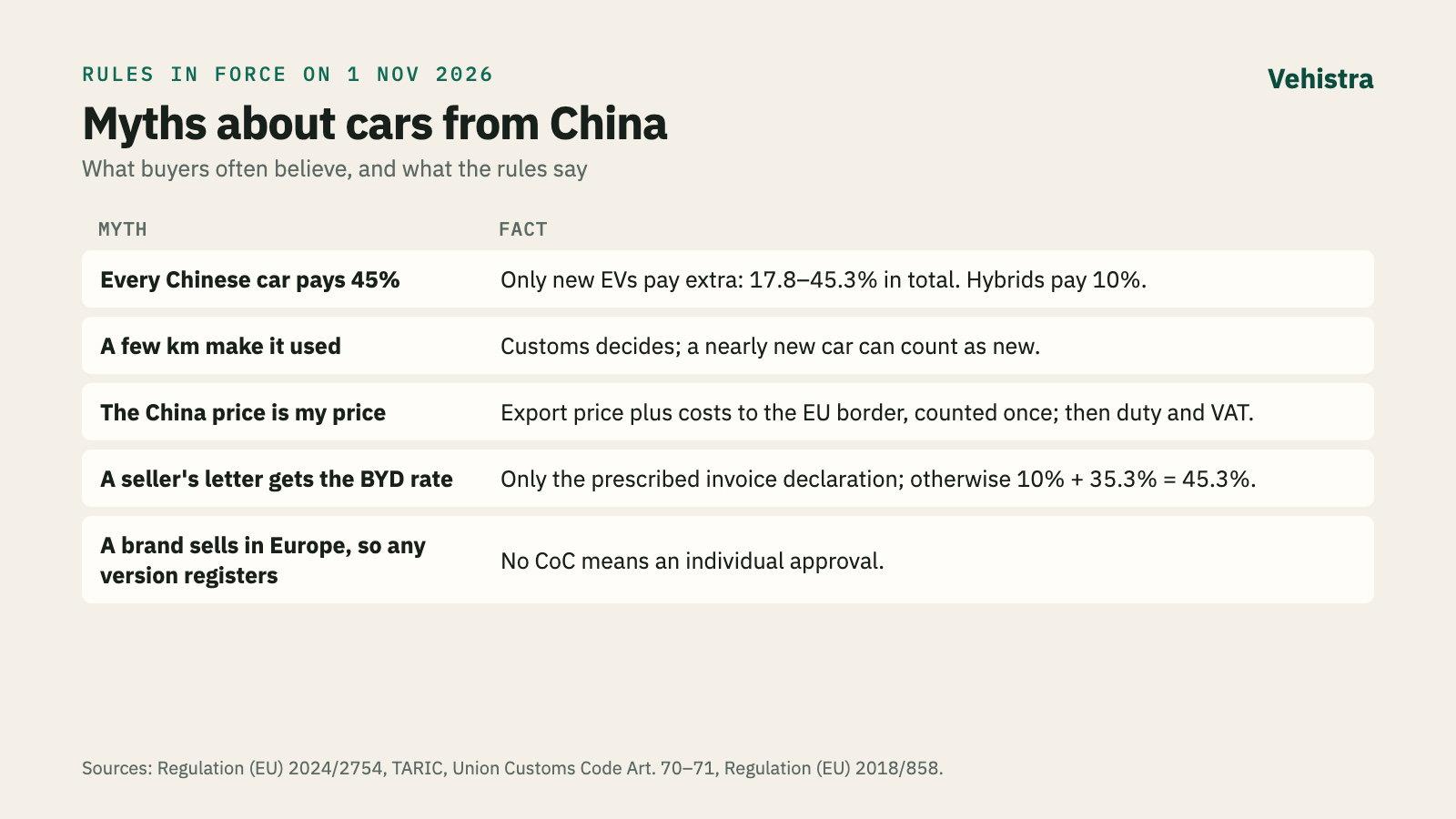
"Every Chinese car pays 45% duty"
It doesn't. The 45.3% total applies to a new battery-electric car from SAIC or a producer not named in the regulation: 10% customs duty plus 35.3% countervailing duty. Tesla from Shanghai pays 17.8% in total, BYD 27.0%, Geely 28.8%, other cooperating makers 30.7%. Qualifying VW Anhui imports under the accepted price undertaking pay no countervailing duty. Conventional hybrids, plug-in hybrids, petrol and diesel cars pay 10%, but a car driven only by electric motors stays in scope even with a petrol range extender. The rates per manufacturer and the hybrid exception have the details.
"A few kilometres on the clock make it used"
Used battery-electric cars fall under CN 8703 80 90, which in TARIC carries only the 10% duty. That makes "nearly new" EVs tempting. But customs decides whether a car is used, not the seller. A car registered in China for a few days and shipped with minimal mileage can still be treated as new and pay the countervailing duty.
"The price in China is what I'll pay"
A Chinese list price is the domestic price of the China-market version. Customs starts from the price paid for the car sold for export to the EU, plus freight and insurance to the EU border. For a 1,498 cm³ plug-in hybrid bought for €30,000, the Vehistra calculator estimated €49,882 in Germany with default costs. The customs value guide shows every line.
"A letter from the seller gets me the BYD rate"
BYD's 17% applies only if the commercial invoice carries the declaration worded as the regulation prescribes, signed by an official of the invoicing company and naming the producer, its address and its TARIC additional code. A free-form letter does not count. Without the declaration a new EV pays 35.3% on top of the 10% duty.
"If the brand sells in Europe, any version will register"
The EU version comes with a certificate of conformity (CoC), which the manufacturer issues for cars built to the EU-approved type. A China-market version usually has none. It needs an individual approval, EU-wide or national, and may need a charging adapter or other changes.
"Every plug-in hybrid is excise-free in Poland"
Only plug-in hybrids with an engine up to 2,000 cm³ are exempt, and only until 31 December 2029. A hybrid over 2,000 and up to 3,500 cm³ pays 9.3%. In Spain the test is CO₂: 0% registration tax up to 120 g/km, then default rates from 4.75%.
"Britain charges the same as the EU"
Great Britain did not adopt the countervailing duty. A China-built car pays 10% customs duty and 20% VAT. A car without recognised approval normally needs individual vehicle approval (IVA) before registration, unless an exemption applies.