
Since 1 July 2026 a car built in the United States has entered the EU at 0% customs duty instead of 10%. The regulation applies until 31 December 2029, but the Commission can suspend the relief earlier. Around it, five myths keep costing buyers money.
The end date: 31 December 2029
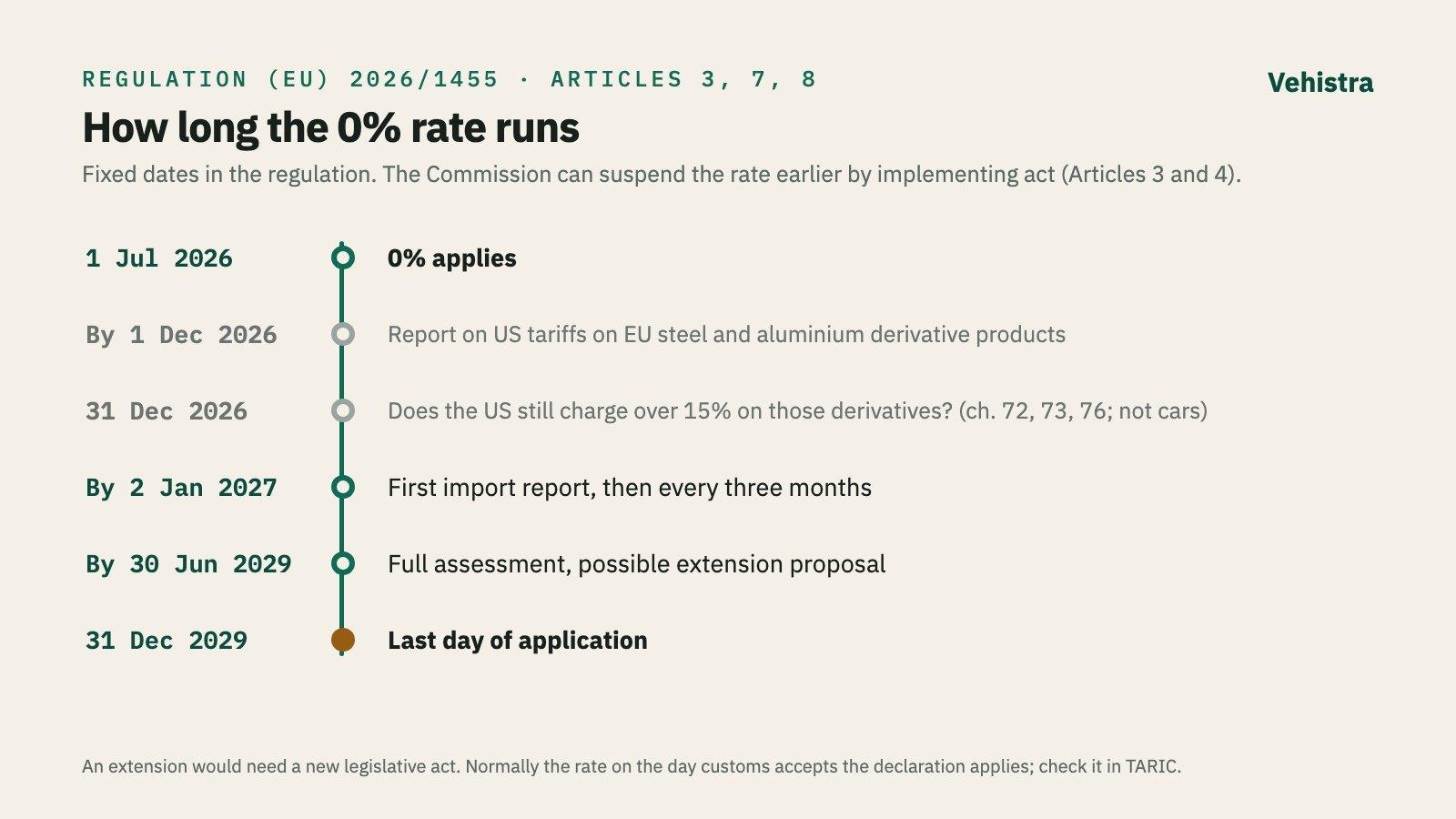
Article 8 of Regulation (EU) 2026/1455 is precise: it applies from 1 July 2026 until 31 December 2029. Article 7 sets a timetable before that. The Commission monitors imports of US goods covered by the regulation. The first report is due by 2 January 2027, with reports every three months thereafter. By 30 June 2029 it must present a full assessment and, where appropriate, a proposal to extend the regulation. An extension is possible, not automatic.
Two ways it can stop earlier
Suspension (Article 3). The Commission can suspend the 0% rate in whole or in part by implementing act if the United States fails to implement the joint statement of 21 August 2025, otherwise undermines its objectives, or discriminates against or targets EU businesses operating, or seeking to operate, in the US. Sufficient indications that this will happen, or a change in objective circumstances, can also justify it. Article 3(1)(a) specifically covers a US failure to address EU concerns, when the Section 122 surcharge expires or is replaced, about exports that benefited before 24 February 2026 from the 15% all-inclusive tariff ceiling or exemption from additional tariffs. Expiry of the surcharge alone is not the trigger.
Safeguards (Article 4). If the tariff relief causes increased imports of a US-origin product that cause or threaten serious injury to EU industry, the Commission may suspend the relief for that product. The Commission must investigate a duly substantiated request from at least three Member States. Requests may also come from Union industry, persons acting on its behalf, or associations acting for industry or trade unions, subject to sufficient initial evidence of serious injury or its threat. The Commission may also act on its own initiative.
Steel and aluminium (Article 3(2)). This clause concerns US tariffs on EU steel and aluminium derivative products. The Commission must report by 1 December 2026. If the US still charges more than 15% on those products on 31 December 2026, it may suspend Article 1 for CN chapters 72, 73 and 76 by implementing act; suspension is not automatic. This specific clause does not cover cars in chapter 87. The broader powers in Article 3(1) and Article 4 can.
What this means for a bid
Buying today does not lock in today's duty rate. Delays in obtaining the title, shipping or customs clearance can move the declaration date. Before bidding, calculate both the 0% scenario and the normal duty scenario for the car's tariff code. Check the rate in TARIC before you bid and again before the declaration. Normally, the applicable rate is the rate in force when customs accepts the declaration for release for free circulation.
Five myths
1. "Every car from a US auction is duty-free." No. Only cars of US origin, which means built in the US. A Mexico-built Audi Q5 or a Canada-built RAV4 from the same Copart yard normally pays 10%.
2. "The VIN proves it." No. A decoded VIN is supporting evidence, not sufficient proof of origin. Customs also requires evidence of direct transport, or qualifying transit under customs supervision without alteration. A VIN and a window sticker do not automatically satisfy these requirements.
3. "No duty means no tax." No. Import VAT stays, and so do Polish excise and the Spanish registration tax where they apply. Removing duty lowers the import VAT base; it does not remove VAT.
4. "North American is close enough." No. The regulation is about US origin only. USMCA, the US–Mexico–Canada agreement, has no effect on EU duty. Cars from Mexico or Canada may qualify for other EU preferences, but those have their own origin and evidence rules.
5. "It is permanent." No. It runs until 31 December 2029 and can be suspended earlier. Article 6 also says the non-preferential origin rules apply until preferential rules are adopted, so the evidence requirements may change too.