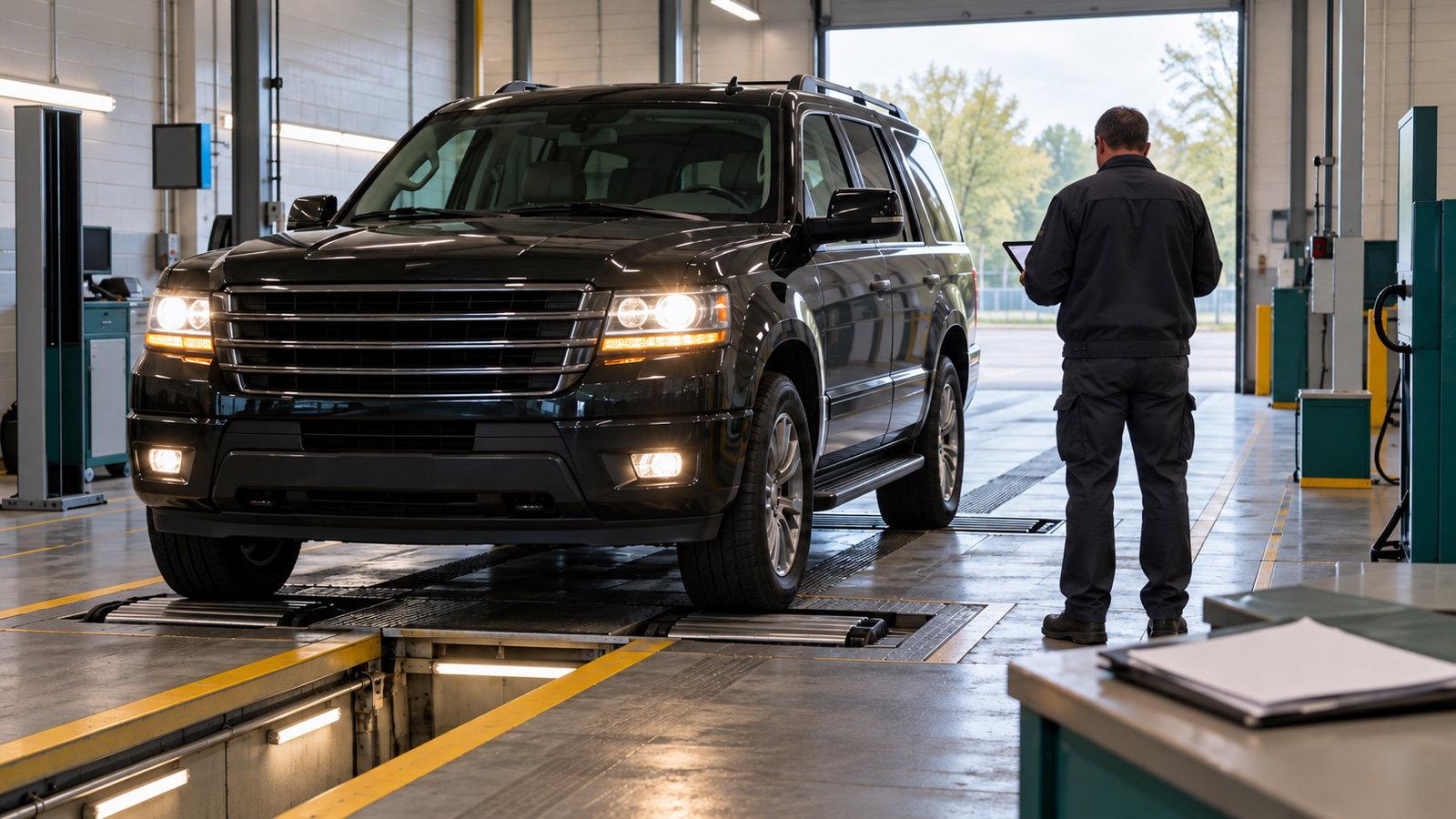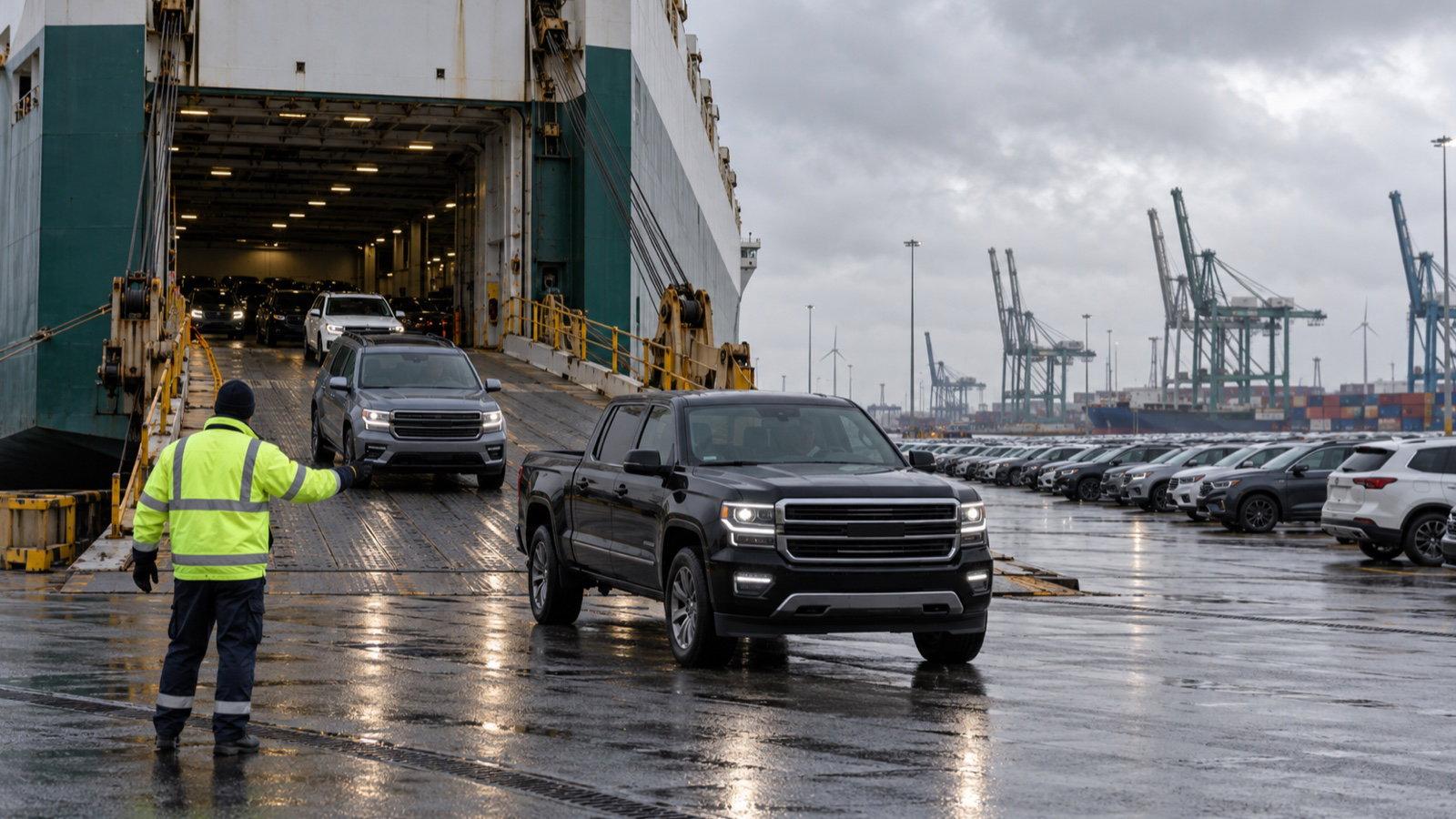
A US auction car or a Chinese electric car can look cheap next to Belgian asking prices. Once it lands in Antwerp or Zeebrugge, the car goes through Belgian customs and 21% import VAT, the duty depends on where it was built, a car without EU type approval needs an individual approval, and the region where you live sets a registration tax that can reach several thousand euros. This guide gives the 2026 rates, worked examples for Flanders, Wallonia and Brussels, and the cash-cost thresholds against a comparable car already registered in Belgium.
Import rules for Belgium in 2026
New: 0% duty on US-built cars. Regulation (EU) 2026/1455 of 25 June 2026, Art. 1(1), sets 0% customs duty for goods of US origin listed in Annex I, which covers CN chapter 87 with passenger cars. Under Art. 8 it has applied since 1 July 2026 and runs until 31 December 2029. Origin follows the EU's non-preferential rules (Art. 6): in practice the car has to be manufactured in the US, not just sold there. A BMW X5 from Spartanburg, South Carolina can qualify; a BMW 3 Series from Munich bought at a US auction cannot. The Commission can suspend the reduced rate, so check the rate on the day of clearance.
The proof of origin must also show that the car was transported directly from the US to the EU, or that it stayed under customs supervision while it passed through another country and, if stored or split there, underwent nothing beyond keeping it in good condition or adding marks, labels, seals or documents needed to meet specific requirements (Art. 59a of the Union Customs Code implementing rules). A ro-ro sailing from a US port straight to Antwerp or Zeebrugge with its bill of lading is the simple case; a car routed through a third country needs transit or non-manipulation documents, and the evidence has to be in hand when the declaration is filed.
For an ordinary passenger car (CN 8703) without US origin, for example one built in Mexico, Canada, Japan, China or the EU, budget the standard 10% unless another documented preference or relief applies. FPS Finance gives the same figure: "in general, the rate is 10% for a passenger car". Pickups can fall under other headings with other rates.
How to check where the car was built:
The European Commission's guidance on the new rule says a decoded VIN is not sufficient proof of origin and that "made in USA" labels or origin statements on an invoice are not enough on their own. The importer carries the burden of proof. Budget 10% and treat 0% as a saving once customs has accepted the origin of that car.
Since October 2024: an extra duty on new Chinese-made BEVs. New battery-electric cars made in China pay a countervailing duty on top of the 10% under Implementing Regulation (EU) 2024/2754: 17.0% for BYD, 18.8% for Geely, 35.3% for SAIC, 7.8% for Tesla Shanghai, 20.7% for other cooperating producers and 35.3% for the rest. The company rate applies only with a valid commercial invoice carrying the prescribed signed declaration that names the producer and its TARIC additional code; without it customs uses the residual rate. Cars driven only by electric motors are covered even with a combustion range extender. Since 2026 an import made under a price undertaking accepted by the Commission can be exempt, but only through that producer's approved sales channel, not for any private import of the same model.
How duty and import VAT add up in Belgium
FPS Finance describes three ways to clear a car bought outside the EU. If the car enters the EU through a Belgian customs office, for example in Antwerp, it is declared in PLDA, the customs IT system, and in practice you hire a customs representative to file it. You can also clear it in the member state where it lands and pay that state's VAT, or move it under a T1 transit document to a Belgian customs office and clear it there. The examples below assume clearance in Belgium:
A private buyer bears the import VAT as a cost. A VAT-registered business can deduct it only if it meets the usual conditions for that car, so the examples are for a private buyer.
Worked examples: US-built, built elsewhere, Chinese EV
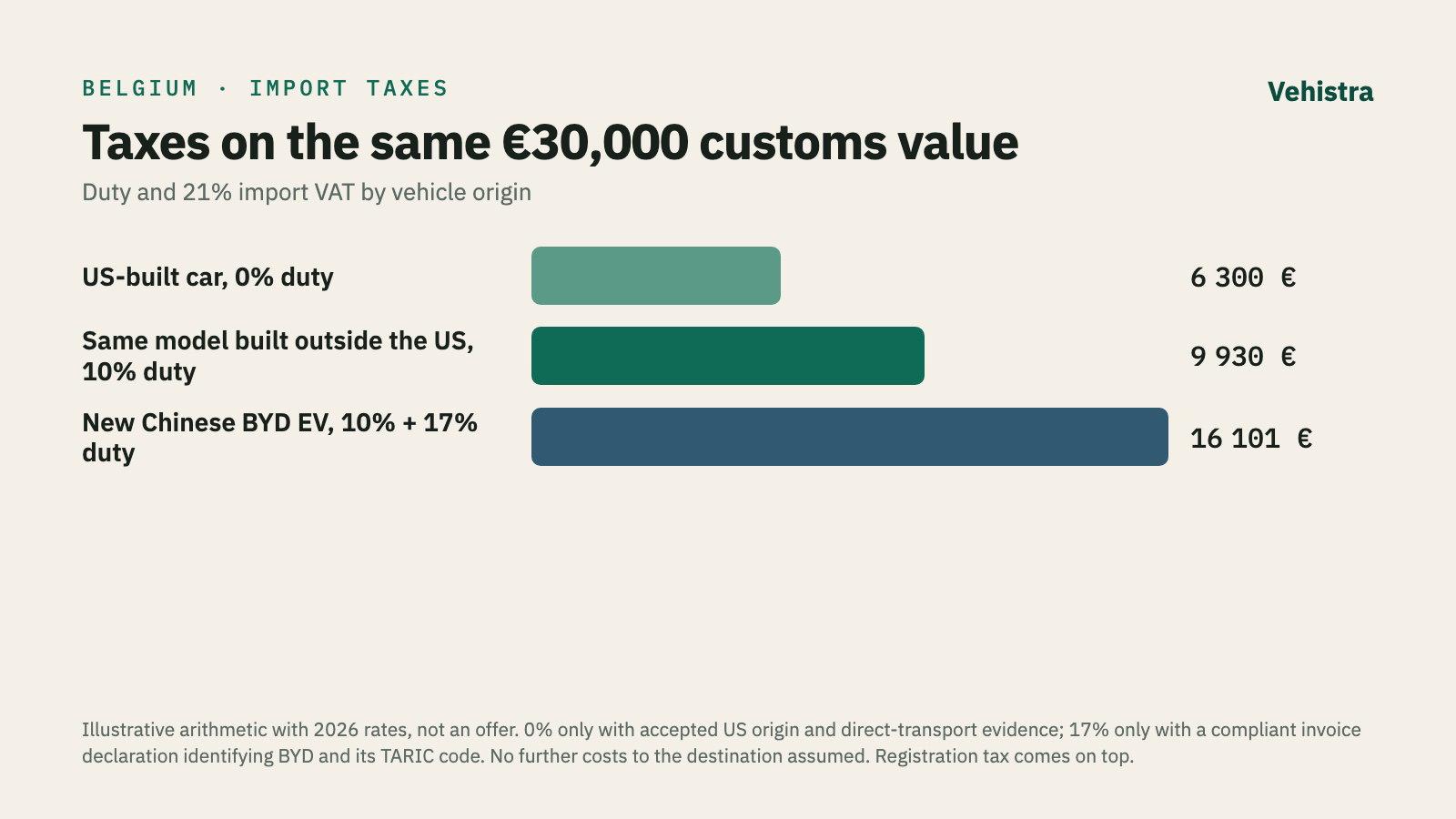
Take a customs value of 30,000 euros for a passenger car, with no further costs to the destination. Duty = customs value × duty rate; import VAT = (customs value + duty) × 21%. These illustrate the arithmetic with 2026 rates and are not offers:
Registration tax: three regions, three formulas
The one-off registration tax (BIV in Flanders, taxe de mise en circulation in Wallonia and Brussels) is regional and follows the address of the person on the registration certificate. It is normally due on a used car too when a different person registers it, with exceptions such as transfers between spouses, and the age discount counts from the first registration anywhere, in Belgium or abroad. The figures below are for a privately registered car that is not leased; leasing companies have their own scales.
Flanders
For a car first registered in 2021 or later the Vlaamse Belastingdienst uses BIV = (((CO2 × f × q) / 246)^6 × 4,500 + c) × LC. CO2 is the WLTP value, f is 1 for petrol and diesel, q is 1.07 for 2021 plus 0.035 a year, c depends on fuel and Euro standard (28.54 euros for a Euro 6 petrol car from 1 July 2026), and LC is the age correction from 100% down to 10%. The tax is at least 58.16 and at most 14,539.31 euros. If the CO2 value is not known, Flanders calculates a default from engine capacity, kW, fiscal horsepower and seats, so ask before you buy a US car without an EU CO2 figure. Zero-emission cars registered from 1 January 2026 pay a flat 61.50 euros.
Wallonia
For cars registered from 1 July 2025 the tax is MB × CO2/X × MMA/Y × C. MB is the base amount by kW (from 64.01 to 5,159.25 euros between 1 July 2026 and 30 June 2027) reduced by age. X is 136 for a WLTP CO2 value and 115 for an NEDC one; SPW Finances asks for the combined figure from the CoC, not the weighted value used for plug-in hybrids. MMA is the maximum authorised mass and Y is 1,838. C is 1 for petrol and diesel, 0.8 for hybrids and 0.01 to 0.26 for electric cars by power (for those CO2/X counts as 1). The result is between 50 and 9,000 euros; qualifying large families and, for registrations from 1 July 2026, single-parent families may get up to 250 euros off; the two reductions cannot be combined and the 50 euro minimum still applies. The old eco-malus belongs to the rules for cars registered before 1 July 2025.
Brussels
Bruxelles Fiscalité charges by fiscal horsepower or kW, whichever gives the higher amount, and by age, from 78.88 to 6,357.85 euros. Electric cars pay the 78.88 euro minimum, and a hybrid is taxed on the power of its combustion engine. A pickup registered by a private person from 1 January 2025 is taxed as a passenger car.
One car in three regions
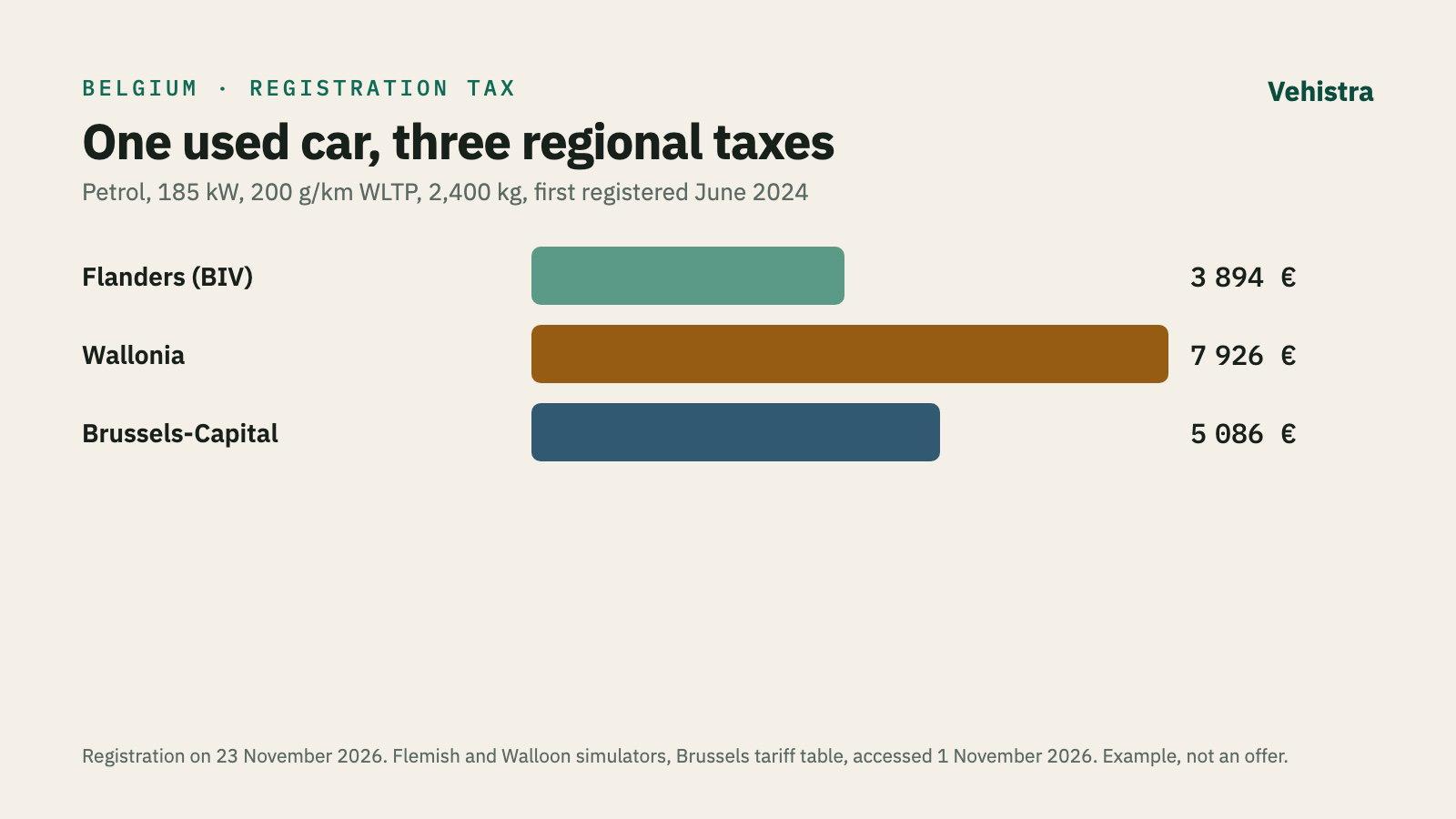
Take a 2.0-litre turbo petrol, 185 kW, 200 g/km WLTP, Euro 6, 2,400 kg maximum mass, first registered on 15 June 2024 and registered in Belgium on 23 November 2026, with no family reduction. The Flemish simulator gives 3,894.41 euros, the Walloon simulator 7,925.62 euros, and the Brussels table 5,086.28 euros (above 155 kW, two to three years old). A new 150 kW electric car with a 2,250 kg maximum mass would pay 61.50 euros in Flanders, 78.88 in Brussels and about 316 in Wallonia.
The annual road tax is regional too. In Wallonia and in Brussels a car of 11 fiscal horsepower pays 561 euros a year from 1 July 2026, and an electric car in Brussels 107.18. In Flanders our example car comes out at 562.82 euros in the simulator and a zero-emission car registered from 2026 at 107.16. Flanders plans to reform its annual tax from 1 January 2027, still subject to approval by the Flemish Parliament.
When a car already registered in Belgium is cheaper
The estimated cash cost of an import before registration tax = customs value + taxes + costs after clearance + expected repairs + contingency. Count the costs after clearance as gross amounts a private buyer pays, VAT included: the customs representative, conversion, approval, inspection and the plate. Transport to the declared destination belongs in the import VAT base; ask your representative which of your quotes are already in it, so nothing is counted twice.
Assume 3,500 euros for those, a 3,000 euro repair estimate and a 1,000 euro contingency; use your own quotes. The car built outside the US then costs 30,000 + 9,930 + 7,500 = 47,430 euros, the US-built one 30,000 + 6,300 + 7,500 = 43,800 euros. An undamaged EU-specification BYD with a valid EU CoC needs no repairs or conversion; with 2,000 euros after clearance it costs 30,000 + 16,101 + 2,000 = 48,101 euros, to compare with the same version at a Belgian dealer.
Calculate the registration tax for both cars. For a local car of the same version and first-registration date it is often the same, but a US-specification car can have different recorded CO2, power or mass, and in Flanders an import without a recorded CO2 value is taxed on the default formula. Only when both amounts match can you leave the tax out of the comparison. A genuinely comparable car already registered in Belgium priced below those totals costs less in cash; condition, repair quality, warranty and resale value still decide whether it is the better car. A private sale carries no VAT; from a dealer compare the final price you pay.
The local car also gives you a test drive and, from a professional seller, the legal guarantee of two years. For a used car the sales contract can reduce it to no less than one year, and only if you are told clearly and unambiguously, according to FPS Economy. When a Belgian-registered used car is sold to a private buyer, by a dealer or by another private person, the seller must hand over a Car-Pass no older than two months; without it the buyer can ask a court to dissolve the sale. The Car-Pass lists the recorded mileage, the Euro standard and CO2 figure where available, and any required post-accident inspection. Mileage from abroad may be missing.
Importing from a US auction to Belgium
A title that can leave the US does not mean the car can be registered in Belgium. Before you bid:
Ordering a car from China to Belgium
Several Chinese brands sell officially in Belgium with EU type approval, dealers and a warranty. A private import can still make sense for price or a version not sold here, but only if that exact car can be registered and serviced. Before a deposit, get the CoC or type-approval evidence for the VIN and variant, check the charging connector and protocol with a demonstrated AC and DC charge, and get in writing who gives the warranty in Belgium and whether diagnostics and parts are available. A missing CoC does not prove the car lacks EU type approval: ask the manufacturer's EU representative or the homologation service whether the version is approved and a CoC can be issued; if it is not approved, the individual-approval route applies as for a US import. Our export checklist for new cars from China lists the documents to request.