
A price you find on a Chinese dealer site is the price of a car built for China and sold to buyers in China. It is not what you will pay in Europe, and it is not what EU customs works from. Duty and VAT start from the price paid for the car sold for export to the EU, plus the cost of getting it to the EU border. In the Vehistra calculator, a car with a €30,000 purchase price came to €49,882 in Germany. Here is how that bill is built under the rules in force on 1 November 2026.
A list price in China is a domestic price
A domestic list price belongs to the China-market version: its trim, its software and its sale to a buyer in China. An export quote can differ from the Chinese list price. Check that it covers the exact version you want. Treat a Chinese list price as a reference, not as the first line of your budget. The first line is the written price from the seller who will put the car on a ship.
What EU customs counts
The Union Customs Code sets the customs value. Article 70 makes it the transaction value: the price actually paid or payable for the car when sold for export to the EU. That includes every payment made as a condition of the sale, so a separate "export fee" paid to the seller is part of it.
Article 71 then adds, if you pay them and they are not already in the price:
The 10% customs duty is charged on this value. For a new battery-electric car, the countervailing duty per manufacturer is charged on the same base.
Transport after the border: no duty, but VAT
Article 72(a) leaves transport after the car enters the EU out of the customs value. It does not disappear. Under Article 86 of the VAT Directive, import VAT is charged on the customs value plus duties and taxes due on import, plus incidental costs up to the first place of destination. If a further destination in the EU is known at import, transport to it is included too.
A €30,000 car, landed in Germany
We ran the Vehistra import cost calculator on 1 November 2026 for a plug-in hybrid with a €30,000 purchase price on the China export route, with the default costs. A plug-in hybrid pays no countervailing duty, so the bill shows the basic mechanics.
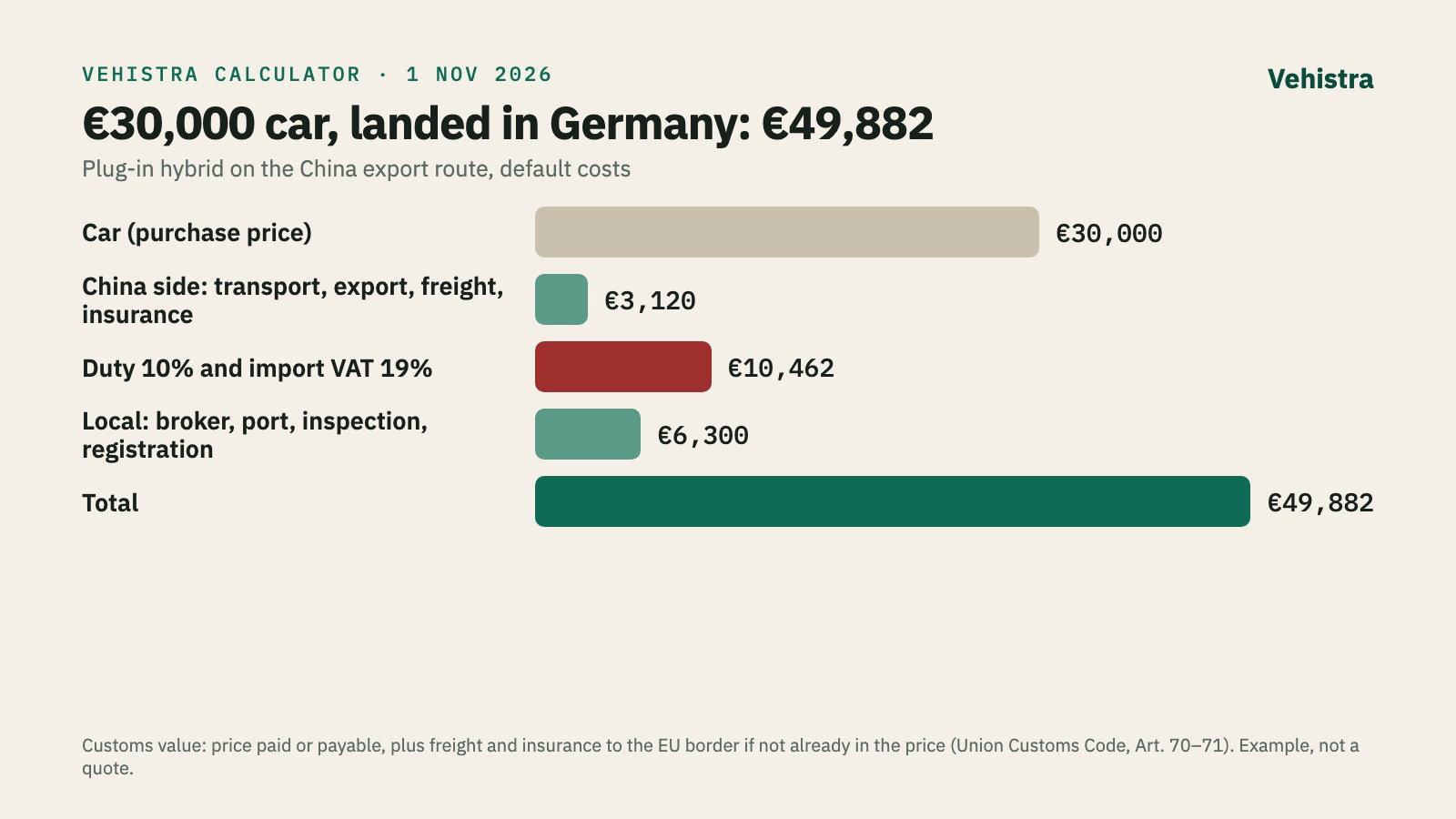
The same purchase price came to 197,755 zł in Poland and €50,635 in Spain. A new BYD electric car with its 17% countervailing duty came to €56,582 in Germany. These are worked examples with default costs, not quotes.
FOB or CIF: where the seller's price ends
Price terms tell you which costs are already in the seller's price:
For EU customs the result is the same: freight and insurance up to the EU border are part of the customs value. What changes is who arranges them and whether they are already on the seller's invoice.