
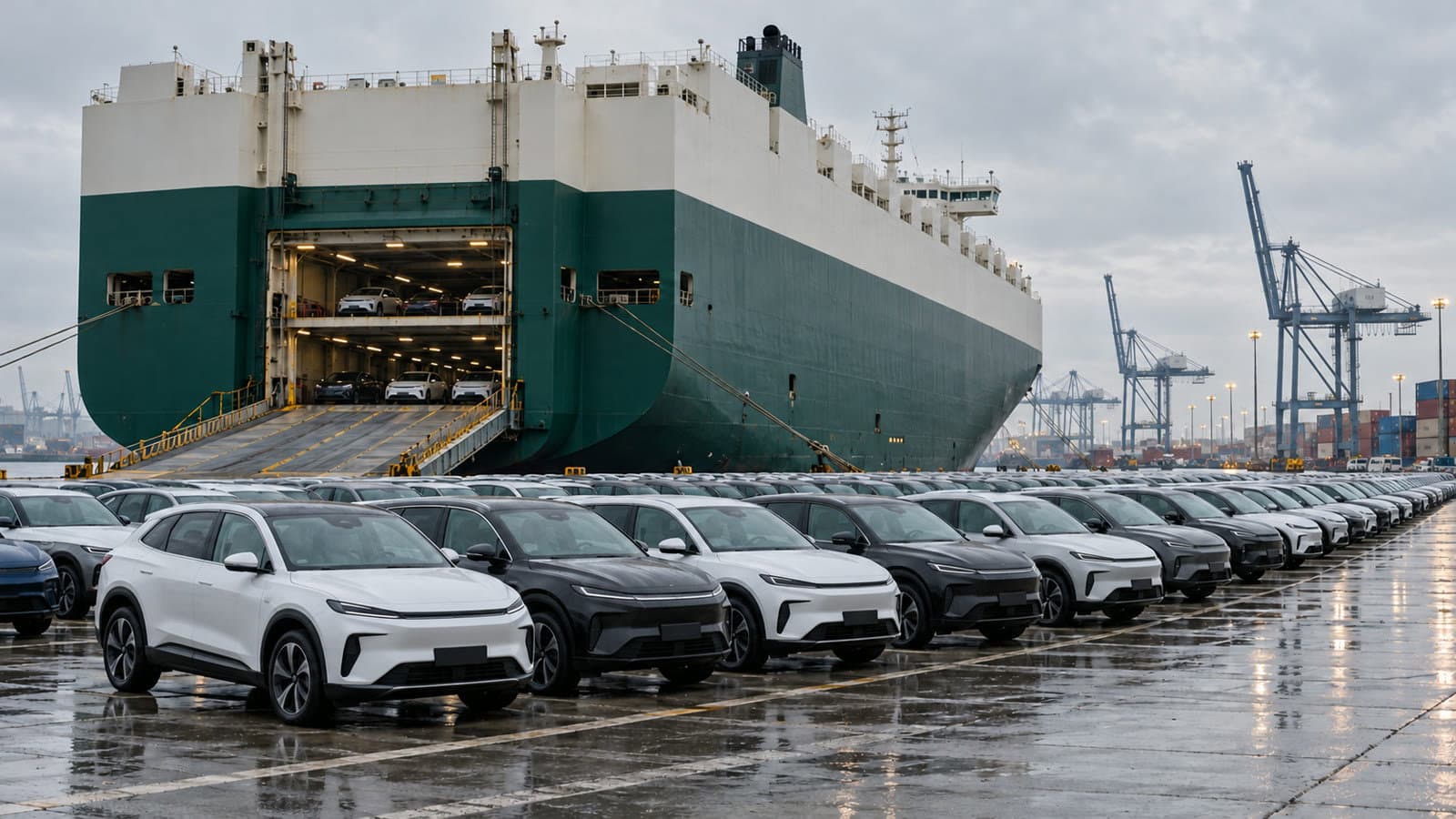
A new electric car built in China pays more than the 10% customs duty when it enters the European Union. Since 30 October 2024 it also carries a countervailing duty, and the rate depends on who built the car: 7.8% for a Tesla from Shanghai, 17.0% for a BYD, 35.3% for an MG from SAIC. This guide lists the rates in force on 1 November 2026, shows how they are charged and explains which China-built cars still pay 10% only.
What a car from China pays at the EU border
Every passenger car imported from China pays the EU's standard 10% customs duty. On a new battery-electric car, the countervailing duty from Implementing Regulation (EU) 2024/2754 comes on top. Both duties are charged on the customs value: what you paid for the car plus freight and insurance to the EU border.
Import VAT is charged on the customs value plus both duties, any other import taxes, and incidental costs not already in the customs value, such as transport and insurance to the first destination in the EU and to any further destination known at import, so the extra duty is taxed again. National taxes are a separate step: a battery-electric car is exempt from Polish excise, and Spain's registration tax, assessed when the car is registered, is normally 0% for an electric passenger car.
Countervailing duty by manufacturer
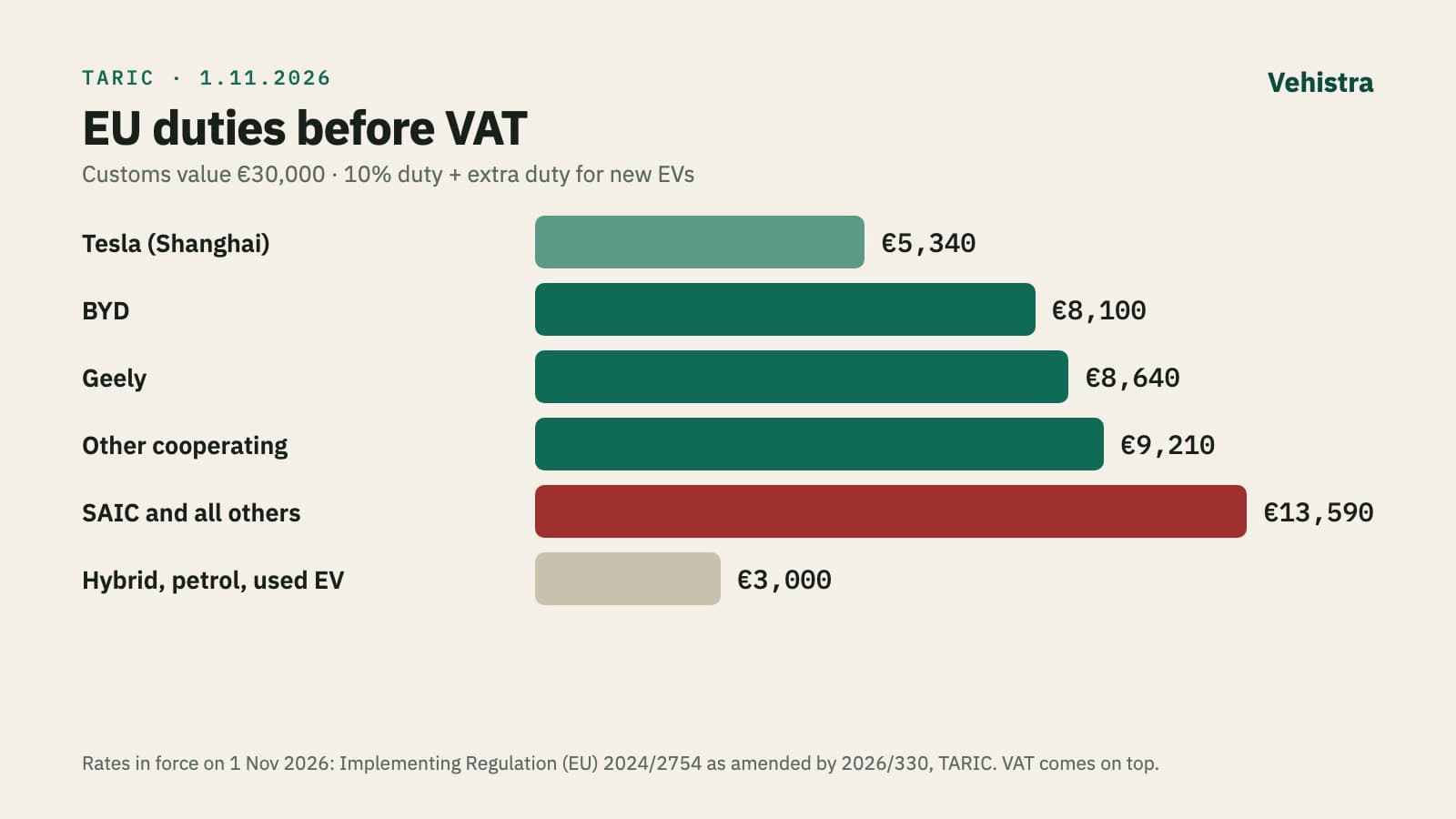
The regulation sets one rate for each group of producers. The figure in brackets is the total with the 10% customs duty:
These are the rates in TARIC on 1 November 2026. The regulation has been amended once since 2024, by Regulation 2026/330, and that amendment did not change any rate.
Worked example: €30,000 customs value
Take a car with a €30,000 customs value at the EU border, and leave out inland transport and other costs that would also enter the VAT base. The duties before VAT are:
With German import VAT at 19% on top, the BYD case comes to about €15,340 in duties and VAT, against €9,270 for a hybrid at the same value.
A separate run of the Vehistra import cost calculator on 1 November 2026 starts from a €30,000 purchase price, not a customs value, and adds the default €3,120 for transport and handling in China and €6,300 of local costs in Germany. The landed cost is €56,582 with BYD's 17% switched on. With the row switched off it shows €49,882; that figure is only a baseline for comparison, because a new BYD covered by the measure cannot be imported without the extra duty.
The invoice decides which rate you get
The maker's rate is not automatic. Article 1(3) of the regulation makes it conditional on a commercial invoice carrying a declaration in the wording the regulation prescribes. It is dated and signed by an official of the invoicing company, named with their function, and states the number of cars, the manufacturer's name and address, its TARIC additional code and that the cars were made in China, and that the invoice information is complete and correct. A free-form letter from the seller does not replace it. If the invoice is missing, customs applies the rate for all other companies, 35.3% on top of the 10% duty.
This matters most for grey imports. If you buy from a trader rather than from the producer's export channel, ask before you pay whether the invoice will carry this declaration, who issues it and which additional code it names. Make sure the commercial invoice your broker files with customs carries the declaration.
Which China-built cars pay only 10%
The countervailing duty covers new cars, for up to nine people, driven only by electric motors, including those with a combustion range extender. A car sold as a hybrid that is in fact driven only by its electric motors, with the petrol engine working as a generator, can therefore fall under the duty. Get its tariff classification confirmed in writing. Outside the measure are:
Customs, not the seller, decides whether a car is used. A car registered in China for a few days and shipped with minimal mileage can still be treated as new.
The one price undertaking: VW Anhui
A producer can offer the Commission a price undertaking instead of paying the duty. Up to 1 November 2026 only one has been submitted and accepted: from Volkswagen (Anhui), the plant that builds the CUPRA Tavascan, together with its EU importer SEAT. It was accepted by Implementing Decision (EU) 2026/328 and applies from 11 February 2026 under Regulation 2026/330. A privately imported Tavascan is not exempt merely because of its model or factory: the exemption needs the supply chain covered by the undertaking, a matching undertaking invoice and declaration, and consignment-tracking details from the Commission's TRON platform. No other undertaking has been published in the Official Journal.
Great Britain is different
Great Britain did not follow the EU. A China-built EV imported into England, Scotland or Wales pays 10% customs duty and 20% VAT, with no countervailing duty. Individual vehicle approval is a separate cost, covered later in this series.