
A US-built car can now enter Spain at 0% customs duty, but 21% import IVA and a registration tax of up to 16% still follow. A new Chinese electric car pays no registration tax, yet it can carry 27% duty or more. Below are the 2026 rates for mainland Spain and the Balearics, four worked examples and the local price below which buying a car already registered in Spain beats importing one.
Import rules for Spain in 2026
New: 0% duty on US-built cars. Regulation (EU) 2026/1455, Art. 1(1) and Annex I, sets 0% customs duty for passenger cars of US origin from 1 July 2026 to 31 December 2029 (Art. 8). Origin follows the EU's non-preferential rules (Art. 6): the car has to be manufactured in the US, not just sold there. A BMW X5 from Spartanburg can qualify; a Toyota from Japan bought at a Texas auction cannot. Check the rate on the day of clearance, because the Commission can suspend it. A passenger car (CN 8703) built in Mexico, Canada, Japan, Korea, China or the EU still pays 10%.
What customs wants to see:
The European Commission's guidance says a decoded VIN, a "made in USA" label or an origin line on an invoice is not enough on its own. Transit through another country is allowed if the car stayed under customs supervision and was not altered. If the transport cannot be proven, the duty is 10% even for a US-built car, so count 0% as a saving only once customs has accepted the evidence.
Since October 2024: extra duty on new Chinese-made BEVs. Implementing Regulation (EU) 2024/2754 adds a countervailing duty on top of the 10%: 17.0% for BYD, 18.8% for Geely, 35.3% for SAIC, 7.8% for Tesla Shanghai, 20.7% for other cooperating producers and 35.3% for the rest. The producer rate needs a signed declaration on the commercial invoice; without it customs applies 35.3%. Cars driven only by electric motors are covered even with a combustion range extender. A price undertaking accepted by the Commission exempts only the transactions it covers, not any import of the same model.
Car import tax in Spain: duty, IVA and IEDMT
The examples assume clearance in mainland Spain or the Balearics, for instance at Valencia, Barcelona or Algeciras. The Canary Islands apply IGIC instead of IVA and lower IEDMT rates, and Ceuta and Melilla have a 0% IEDMT; this guide does not cover them.
Import IVA is not added to the IEDMT base, and the IEDMT is not added to the import-IVA base. For a new car the IEDMT base is the IVA base; for a used car it is the market value (art. 69). For this tax a car is new if it is delivered before six months have passed since it first entered service, or if it has covered no more than 6,000 km, even if it was registered before.
IEDMT bands by official CO2 (art. 70, state rates for the peninsula and the Balearics):
According to the Agencia Tributaria (page updated 3 March 2026), seven communities set their own rates: the top band is 16% in Catalonia, the Valencian Community, Asturias and the Balearics, 15.9% in Murcia and 15% in Cantabria; Andalucía keeps 14.75%. The rate follows the tax domicile of the person registering the car (Ley 22/2009, art. 43), not the port where it lands.
Missing CO2 can put a US car in the top band. A US car is certified to EPA rules, not to the EU WLTP test. Art. 70.7 accepts a certificate from the manufacturer or importer, or a figure on the Spanish ITV card or another official document issued for that car. Where CO2 has to be measured, a combustion car without an accepted official figure pays the top band whatever it really emits, so ask the approval engineer before you bid which CO2 figure will go on the ITV card.
The base for a used import. The 2026 Hacienda tables in Orden HAC/1501/2025 give the market value: the Annex I value for the model × the Annex IV percentage for its years of use (100% up to 1 year, 84% up to 2, 67% up to 3, 56% up to 4, 47% up to 5, down to 10% after 12 years). For a car previously registered abroad, art. 5 removes the indirect taxes it would have paid new in Spain: base = market value ÷ (1 + the IVA rate + the IEDMT rate that would have applied at its first registration in the Spanish territory where it is now registered, plus any other indirect tax in the value); today's IEDMT rate then applies to that base. Years of use run from the first registration in the EU or, failing that, from the oldest liability insurance contract or other admissible evidence, so keep the US title history and insurance papers. For a version missing from the tables you declare a value, which the Agencia Tributaria can check before validating the Modelo 576 (art. 71.2).
Worked examples: 0% versus 10% duty
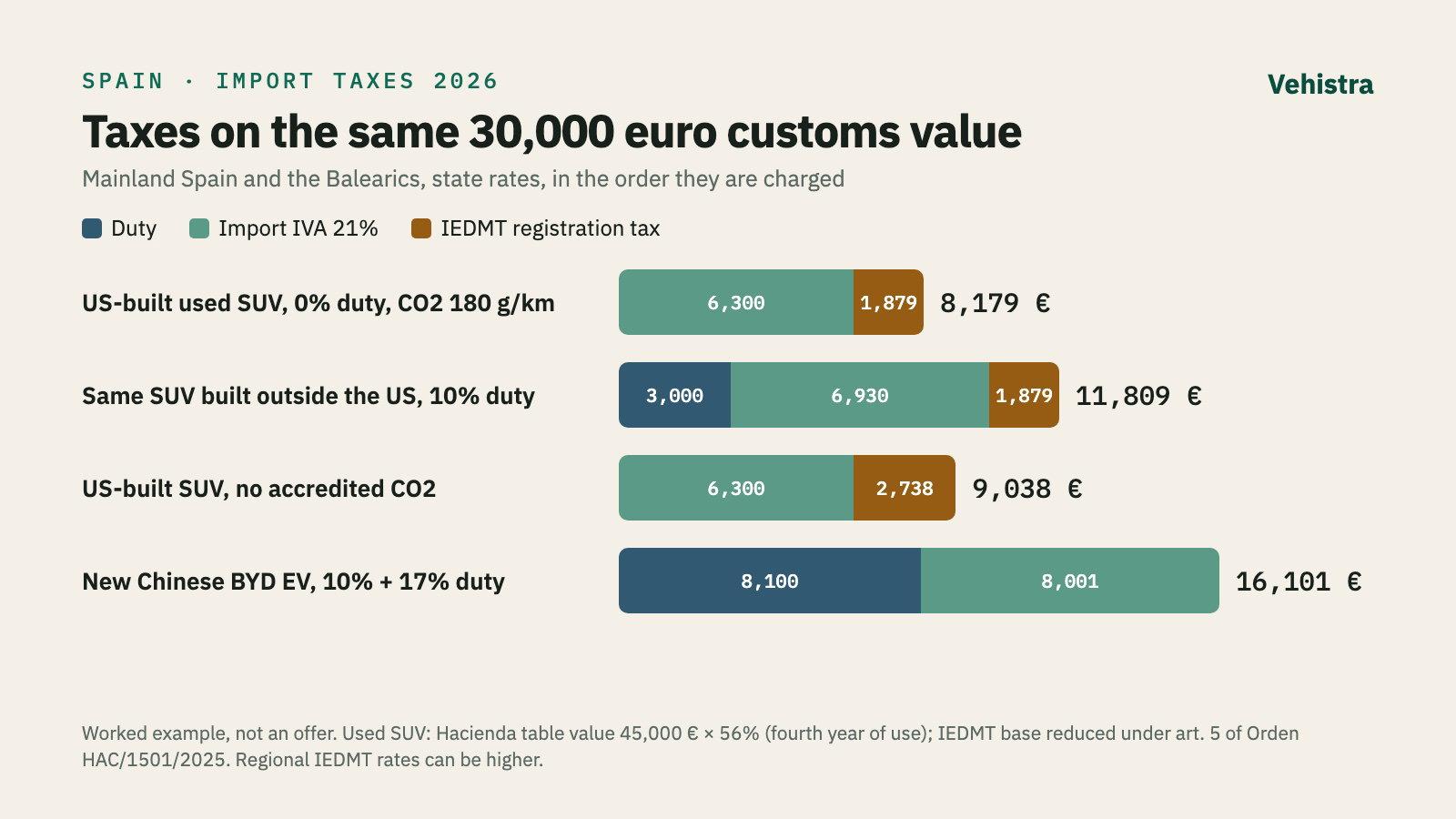
Take a customs value of 30,000 euros, with Valencia as the first destination in the transport documents and all costs to that point, port handling included, already in the IVA base. For the three used cars, take an IEDMT market value of 25,200 euros: a table value of 45,000 euros × 56% for a car in its fourth year of use, with more than 6,000 km, the same IVA and IEDMT rates at its first registration as today and no other indirect tax in the value. The first three use state rates; illustrative arithmetic, not offers.
Buy a car in Spain or import: the break-even price
The estimated total = customs value + taxes + any buying commission paid separately + costs after clearance + expected repairs + contingency. A buying commission is outside the customs value but belongs in the IVA base; the examples assume none. Any incidental cost to the first destination that is not yet included belongs in the import-IVA base. Costs after that are budgeted separately, with IVA where it applies: the technical sheet and approval, ITV, conversions, translations, the 99.77 euro DGT fee, the first IVTM, plates and a gestor.
Assume 4,000 euros for them, a 3,000 euro repair estimate and a 1,000 euro contingency that also covers storage; use your own quotes. The SUV built outside the US then costs 30,000 + 11,809 + 8,000 = 49,809 euros, the US-built one 30,000 + 8,179 + 8,000 = 46,179 euros. Assume an undamaged EU-specification BYD with a matching CoC that needs no repairs or conversion; with 1,000 euros after clearance it costs 47,101 euros, to compare with the same version's price at a Spanish dealer.
A comparable car already registered in Spain and bought from a private seller costs its price + the regional transfer tax (ITP) + the 55.70 euro DGT transfer fee. The ITP base is the highest of the market value, the declared value and the agreed price (Real Decreto Legislativo 1/1993, art. 10), and the state rate for movable goods is 4% where the community has not set its own (art. 11). If the price equals the market value, no higher value is declared and the rate is 4%, the local car is cheaper when price × 1.04 + 55.70 is below the import total: under about 47,840 euros against the 10% import and about 44,349 euros against the 0% import. A sale by a dealer is subject to IVA, sometimes under the margin scheme, and carries no ITP. A change of owner does not trigger the IEDMT again.
A repaired auction car and an accident-free local car also differ in history and resale value. Before paying for a local car, get the DGT vehicle report for liens and ITV history. If you buy as a consumer from a dealer, the seller answers for lack of conformity that existed at delivery and shows within three years; for a used car the contract can shorten that to no less than one year (consumer law, art. 120).
Importing from a US auction to Spain
A title that can leave the US is not a car Spain will automatically register. Before you bid:
Our checklist of shipping documents to track covers the paperwork from auction to port.
Ordering a car from China to Spain
Several Chinese brands sell officially in Spain, so a grey import has to beat them on the full cost including registration, on a specification you can use here and on warranty and service you can actually claim. Before a deposit, get the EU CoC for that VIN and variant; for a car never registered outside the EEA, without approval documents you face a Spanish individual approval under the rules in force on the day of registration (RD 750/2010, art. 5.4 a). Check the charging connector and protocol with a demonstrated AC and DC charge, and get in writing who gives the warranty in Spain and whether parts, diagnostics and the app work here. Our export checklist for new cars from China lists the documents to request.
From the port to Spanish plates
Temporary green plates (tasa 1.4, 20.61 euros) are valid for 60 days while registration is in progress, extendable free of charge if the delay is not your fault; the DGT reminds that the car must be insured and have a valid ITV to be driven. The green plates do not change the tax rule: a Spanish resident who starts using a car in Spain without applying for definitive registration within 30 days owes the IEDMT anyway.
The IVTM is set by your town hall. The law fixes a minimum for cars by fiscal horsepower, from 12.62 euros below 8 fiscal hp to 112 euros from 20 fiscal hp, which the council can multiply by up to 2 (TRLRHL, art. 95): between 12.62 and 224 euros a year before any discount. Councils can cut it by up to 75% for cleaner engines or fuels.
Moving your residence to Spain with a car you already own is a separate case, with its own customs relief and IEDMT exemption; it is not covered here.