
A plug-in hybrid made in China pays the same 10% EU customs duty as a petrol car. The countervailing duty that adds up to 35.3% only applies to new cars driven solely by electric motors. On a car with a €30,000 purchase price going to Germany, that difference is about €6,700 against a BYD electric car. Here is what the rules say on 1 November 2026, the one exception to watch for, and what Poland, Germany and Spain charge after customs.
Which cars the extra duty covers
Implementing Regulation (EU) 2024/2754 applies to new cars for up to nine people that are propelled solely by one or more electric motors, including those with an internal combustion range extender. That is the whole scope. Our guide to the EU duty on Chinese EVs lists the rates per manufacturer.
TARIC on 1 November 2026 shows only the 10% third-country duty, with no countervailing or anti-dumping measure, for:
Import VAT is charged on top in every EU country, on a base that includes the duty.
The range-extender exception
Some Chinese cars sold as hybrids have a petrol engine that never drives the wheels. It only works as a generator for the battery, and the electric motor does all the driving. The regulation names these cars expressly, so they can owe the countervailing duty like a battery-electric car. The seller's label does not decide; the tariff classification does. Ask a customs broker to confirm the CN code in writing before you pay.
The same purchase price, three drives
We ran the Vehistra import cost calculator on 1 November 2026 for a €30,000 purchase price on the China export route, with its default transport and local costs. The hybrid has a 1,498 cm³ engine; the plug-in hybrid has official CO₂ of 30 g/km and the full hybrid 125 g/km.
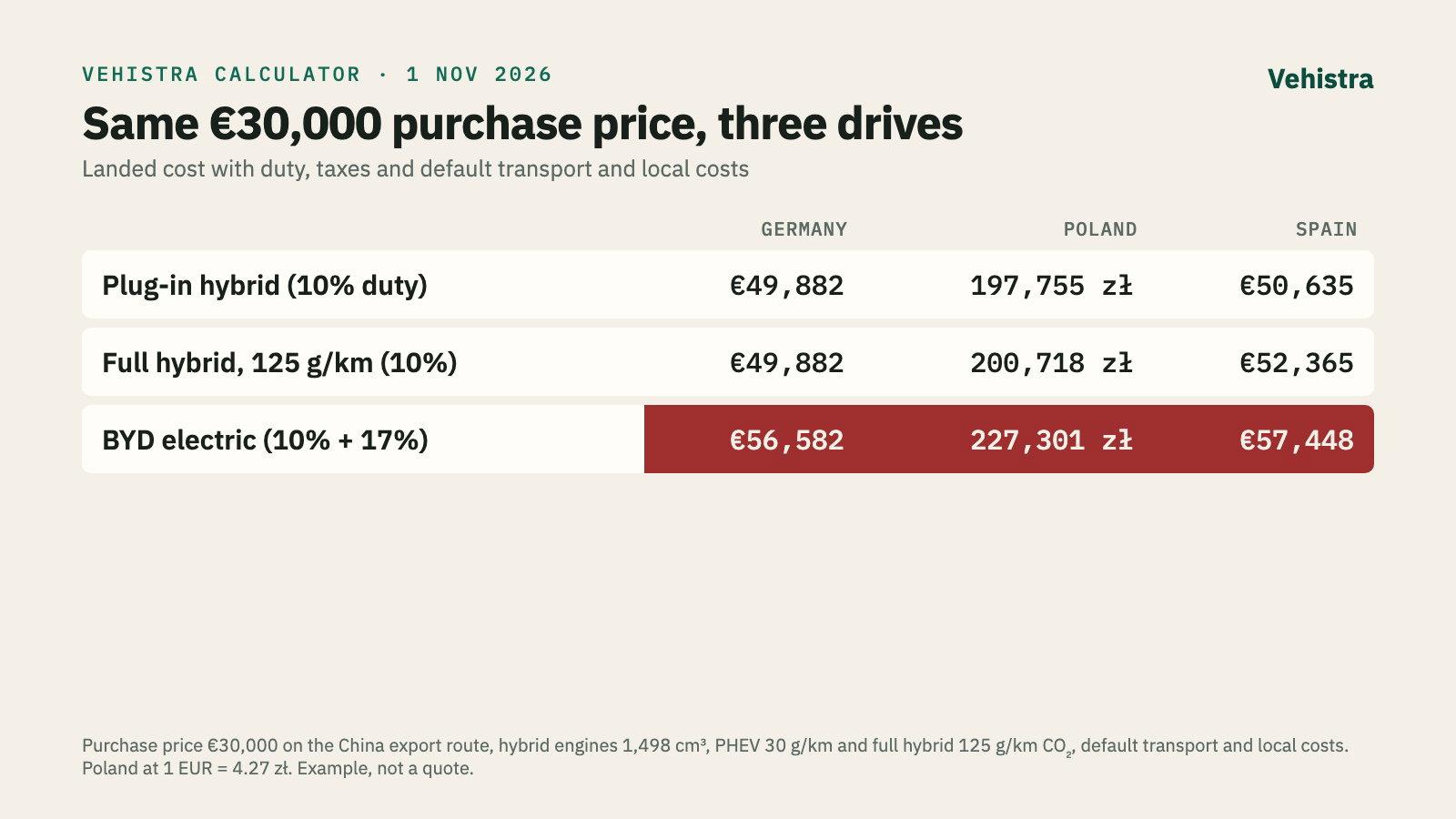
These are worked examples, not quotes. Freight, broker fees and local costs vary by car and port.
Poland: excise by engine size
After customs and before VAT, Poland charges excise on passenger cars. The rates on podatki.gov.pl are:
Excise is part of the VAT base, so a higher rate is taxed again at 23%.
Germany: no registration tax, but annual tax
Germany charges the 10% duty and 19% import VAT and has no one-off registration tax. The difference comes later. Under § 3d KraftStG, an electric car first registered by 31 December 2030 is exempt from annual vehicle tax for ten years, at most until 31 December 2035. A hybrid pays the normal annual tax.
Spain: registration tax by CO₂
Spain's registration tax (IEDMT) is paid when the car is first registered, by official CO₂ emissions under Article 70 of Law 38/1992. Default mainland and Balearic rates, unless the autonomous community has set its own:
Most plug-in hybrids sit below 120 g/km. A full hybrid at 125 g/km already pays 4.75%. The Canary Islands have lower rates.