
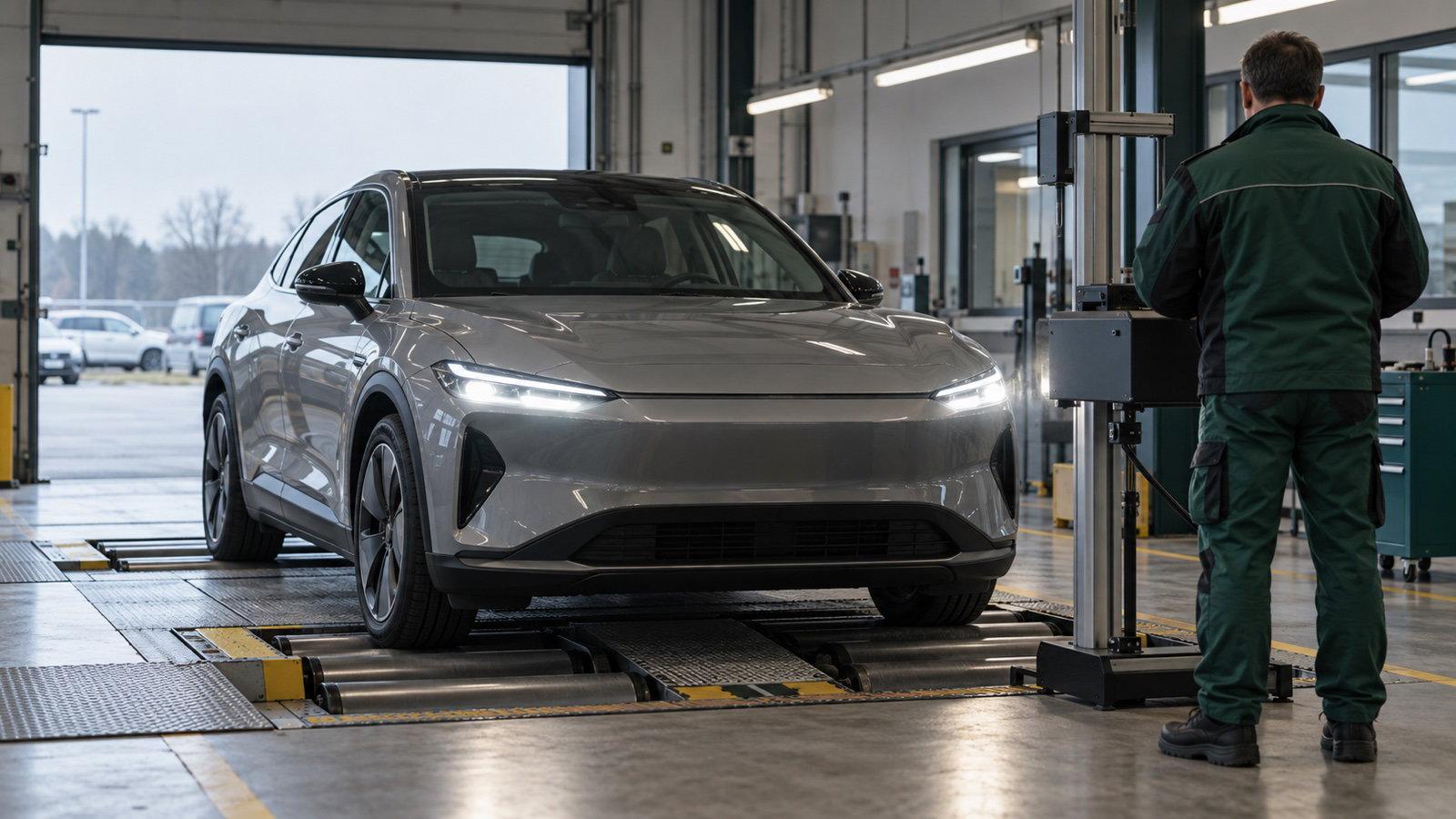
Clearing customs does not make a car road-legal. A car built for the Chinese market arrives without the paperwork EU registration offices expect, and often with a different charging socket, lights and software. Before you budget a China-market car, check which approval route it needs. This guide covers the rules in force on 1 November 2026 under Regulation (EU) 2018/858, what eCall and the EU charging rules mean in practice, and how Great Britain differs.
The simple route: a certificate of conformity
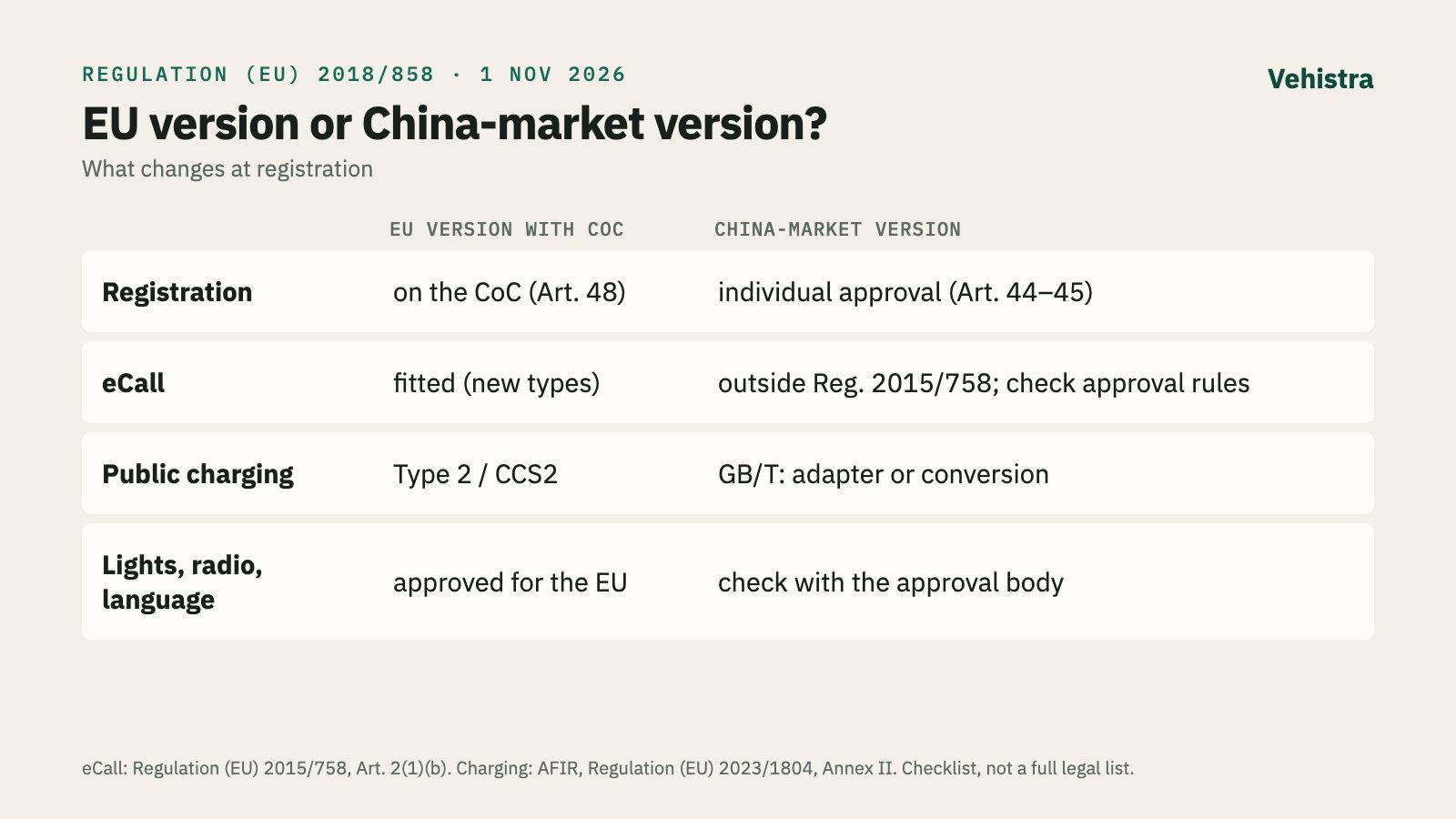
Under Article 48(1) of Regulation (EU) 2018/858, vehicles that need type approval may be registered only with a valid certificate of conformity (CoC). Chinese brands that sell in Europe have EU-approved types, and those cars come with a CoC. If you buy the EU version through a channel that hands over the CoC, registration follows the normal path in your country.
A car built for China is a different vehicle on paper, even when it looks the same. Under Article 36 the manufacturer issues a CoC for each vehicle built in conformity with the approved type, so a China-market car usually has none. Ask the seller in writing whether a CoC comes with the car before you pay anything. The duty you pay at the border does not change this.
Without a CoC: individual approval
Regulation 2018/858 offers two routes for a single vehicle:
Either route means an inspection by an approval body or technical service, documentation, and possibly modifications. The cost and time vary by country and by car, so get a written quote before you commit.
eCall: required for new types, not for every car
Regulation (EU) 2015/758 requires the 112-based eCall system in new types of passenger cars and vans approved in the EU from 31 March 2018. Article 2(1)(b) excludes vehicles approved individually. So a missing eCall module does not, under this regulation, block an individual approval. A CoC alone does not prove eCall: types approved in the EU from 31 March 2018 have it, so check the approval date and the car.
Charging: Type 2 and CCS2 in the EU, GB/T in China
The EU's alternative fuels infrastructure regulation (AFIR) requires public AC recharging points to offer at least Type 2 connectors and DC points at least Combo 2, also called CCS2. China uses the GB/T standard. The rule binds charging operators, not cars, so a GB/T car can still be registered. In daily use it needs an adapter or a socket conversion to charge at public stations. Ask the approval body whether a conversion affects the approval.
Other gaps to check
These are items to raise with the approval body, not a complete legal list:
Great Britain
Great Britain did not follow the EU's countervailing duty. A China-built car pays 10% customs duty and 20% VAT. Before registration, a car without UK approval normally goes through individual vehicle approval (IVA), which exists for a single or a very small number of vehicles, with a basic or a normal inspection.