
Compare what it costs to get the car registered in Poland, not the auction bid or the exporter's invoice. Duty, excise and VAT are stacked on top of each other, a 2026 EU regulation removed duty on US-built cars, and new Chinese-made EVs carry an extra EU duty. Transport, approval work and repairs can then change which option is cheaper. This guide gives the 2026 rates, four worked tax examples and the break-even price for a car already registered in Poland.
Import rules for Poland in 2026
New: 0% duty on US-built cars. Regulation (EU) 2026/1455 of 25 June 2026, Art. 1(1), sets 0% customs duty for goods of US origin listed in Annex I, which covers CN chapter 87 with passenger cars. Under Art. 8 it has applied since 1 July 2026 and runs until 31 December 2029. Origin follows the EU's non-preferential rules (Art. 6): the car has to be manufactured in the US, not just sold there. A Toyota from Kentucky can qualify; a Toyota from Japan bought at a Texas auction cannot. The Commission can suspend the reduced rate under the safeguard in Art. 4, so check the rate on the day of clearance. If the car passes through a third country on the way, for example Canada, it has to stay under customs supervision there with no work done on it; a US-built car that was first imported and used in another country is a different case.
For an ordinary passenger car (CN 8703) that does not have US origin, for example one built in Mexico, Canada, Japan, China or the EU, budget the standard 10% unless another documented relief applies. Collector cars (CN 9705) are classified separately and are outside the examples below.
How to check where the car was built:
Customs can ask for proof, and the importer must keep it. Dutch Customs, for example, says a certificate of origin, a "made in the USA" label or an origin line on the invoice is never enough on its own, and that supporting documents from the US exporter or producer are needed. Ask your broker for a written review that names the evidence; it does not bind customs. Budget 10% and treat 0% as a saving once customs has accepted the origin of that car.
Since October 2024: an extra duty on new Chinese-made BEVs. New battery-electric cars made in China pay a countervailing duty on top of the 10%: 17.0% for BYD, 18.8% for Geely, 35.3% for SAIC, 7.8% for Tesla Shanghai, 20.7% for other cooperating producers and 35.3% for the rest. The producer rate applies only with the required invoice declaration and the right TARIC code; without them customs uses the residual rate. The definition is based on propulsion: cars driven only by electric motors are covered even with a combustion range extender, so an "EREV" or "PHEV" label on a listing settles nothing. Since 2026 an import made under a price undertaking accepted by the Commission can be exempt, but only for that producer's approved sales channel, not for any private import of the same model. Check the current TARIC measure before you pay.
How duty, excise and VAT add up in Poland
The examples assume the car is released for free circulation in Poland, for instance at Gdynia or Gdańsk. A car that arrives in Bremerhaven or Rotterdam can either be released there or travel under customs transit to Poland, and the tax is settled differently in each case; ask the broker which procedure, importer and VAT treatment the quote assumes. Each tax is calculated on a base that includes the one before it:
Excise by engine and drive type, according to the Ministry of Finance:
Mild hybrids: in a general interpretation of 26 February 2026 the Minister of Finance accepted that a car qualifies for the hybrid rate when its electric motor assists the combustion engine; it does not have to drive the car on its own. Check the actual drivetrain in the documents. The step from 3.1% to 18.6% at 2,001 cm3 can add thousands of zloty: a 2.0-litre turbo and a 2.5-litre four-cylinder look alike at auction and are taxed very differently here.
Worked examples: US-built 0% next to 10%
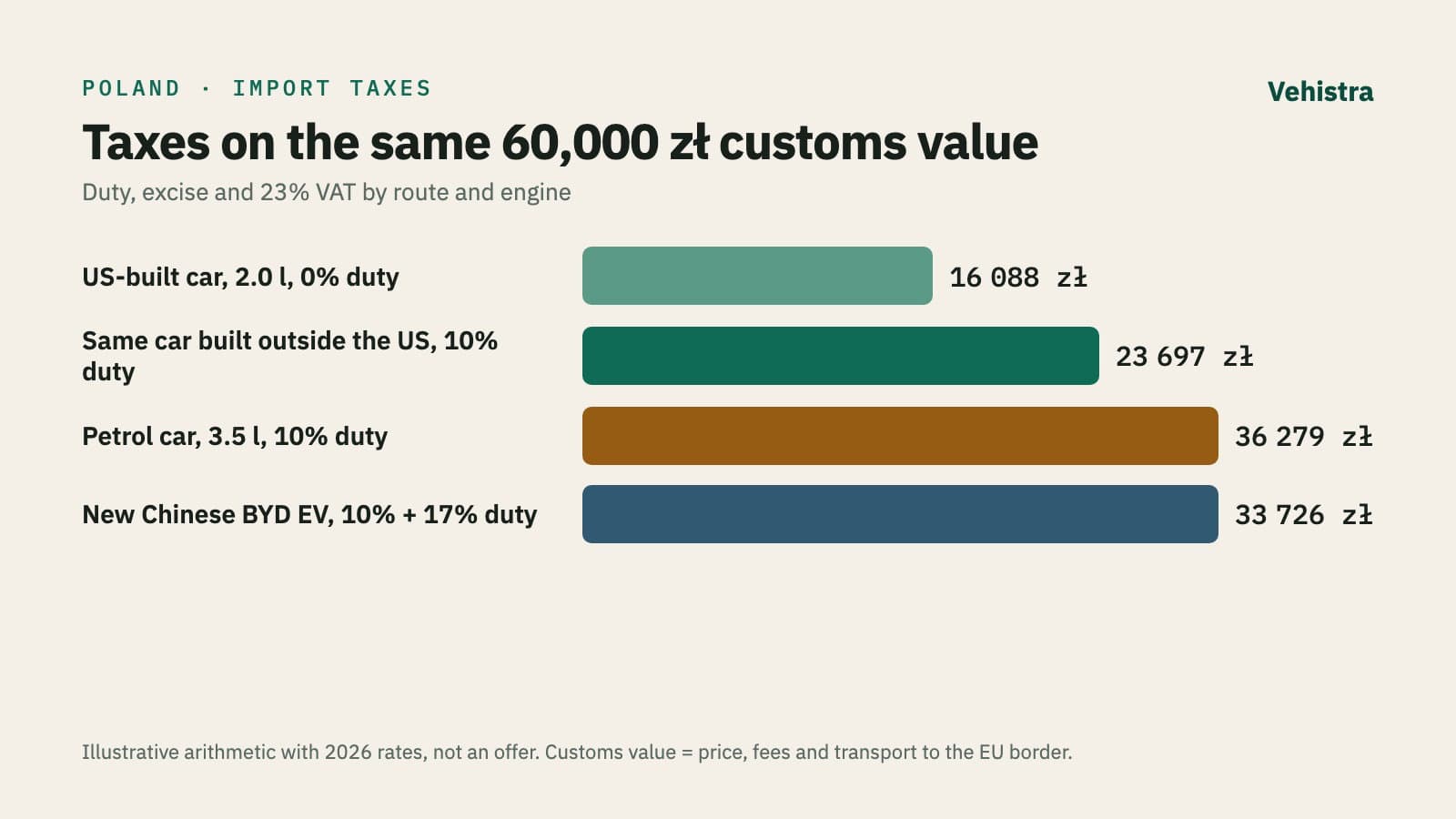
Take a customs value of 60,000 zł for a passenger car, with freight to the Polish place of clearance included and no further incidental costs. The formulas: duty = customs value × duty rate; excise = (customs value + duty) × excise rate; VAT = (customs value + duty + excise) × 23%. Amounts are rounded to the nearest zloty; they illustrate the arithmetic with 2026 rates and are not offers:
When a car already in Poland is cheaper
Taxes are not the whole bill. The total cost ready for registration = customs value + taxes + any buying commission paid separately + costs after clearance + expected repairs + contingency. A buying commission is outside the customs value but belongs in the excise and VAT bases; the examples assume none. They also assume the car is cleared at its first destination in Poland, so the costs after clearance are outside the tax base: onward transport not known at import, the inspection, sworn translations, registration and lighting conversion.
Assume 5,000 zł for those, a 6,000 zł repair estimate and a 2,000 zł contingency; use your own quotes. The 2.0-litre car built outside the US then costs 60,000 + 23,697 + 13,000 = 96,697 zł, the US-built one 60,000 + 16,088 + 13,000 = 89,088 zł. The new BYD needs no repairs; with 3,000 zł after clearance it costs 60,000 + 33,726 + 3,000 = 96,726 zł, to compare with the same version's price at a Polish dealer.
A comparable car already registered in Poland, bought from a private seller, costs its price + 2% PCC on its market value, declared on PCC-3 and paid within 14 days. If the price equals the market value, it is cheaper than the import when price × 1.02 is below the import total: under 94,801 zł against the 10% import and under 87,341 zł against the 0% import. A sale by a business that is subject to VAT, including the margin scheme, carries no PCC; check that the dealer is the seller and not only an intermediary.
Compare like with like: a repaired auction car and an accident-free local car differ in history and resale value. A car already in Poland is usually easier to inspect and test drive before you pay. If you buy it as a consumer from a business, the seller is responsible for non-conformity that existed at delivery and shows within two years, also for a used car; that is separate from any manufacturer warranty. Check that a "local" listing is not a recent import that is still unregistered.
Importing from a US auction to Poland
Auction cars are sold as seen, and many carry a US title (ownership document) branded salvage. A title that can leave the US is not automatically a car Poland will register. Before you bid:
Our US to Poland import guide covers the customs documents in more detail.
Ordering a car from China to Poland
Before paying a deposit, verify that this exact version can be registered, charged and serviced in Poland:
Our guides on importing from China to Poland and Chinese EVs and PHEVs cover approval in detail.
Registration in Poland after import
These steps apply to a private buyer; vehicle traders have 90 days and different fines.