
Since 1 July 2026 a car built in the United States has entered the EU at 0% customs duty. Before that date the same car paid 10%. The change comes from Regulation (EU) 2026/1455, the EU half of the trade deal agreed with Washington in August 2025, and it runs until 31 December 2029. It does not cover every car you can buy in America, and it does not remove VAT. Here is what the text says and what it means for a car from Copart or IAAI.
What the regulation changed
Article 1(1) of Regulation (EU) 2026/1455 sets the EU customs duty at 0% for goods listed in Annex I that originate in the United States. Annex I lists the whole of chapter 87 of the Combined Nomenclature: vehicles, parts and accessories. Passenger cars (CN 8703) fall under it, with no exceptions.
The EU tariff database shows the result. For a petrol car code such as 8703 23 90 00, TARIC lists the normal third-country duty of 10% and, for the United States, a preference of 0% from 1 July 2026.
Built in the US, not bought in the US
The regulation uses non-preferential origin rules (Article 6). For a car that means the country where it was made, in legal terms the place of the last substantial processing. Where the auction was held or which state issued the title (the US ownership document) does not matter.
A BMW X5 from Spartanburg, South Carolina qualifies. A Ford Mustang from Flat Rock, Michigan qualifies. A Toyota RAV4 assembled in Kentucky qualifies, but the same model built in Canada or Japan pays 10%. A Volkswagen sold at a US auction may have been built in Mexico, so it pays the normal 10%. Other EU preferences, for example under the agreements with Mexico, Canada, Japan or Korea, have their own origin, evidence and transport rules, so check them case by case.
What you still pay
The cut applies to customs duty only. VAT, excise and registration fees stay as they were:
Duty is part of the VAT base, so removing it lowers the VAT too. In Poland it also lowers excise, because excise is calculated on the customs value plus duty.
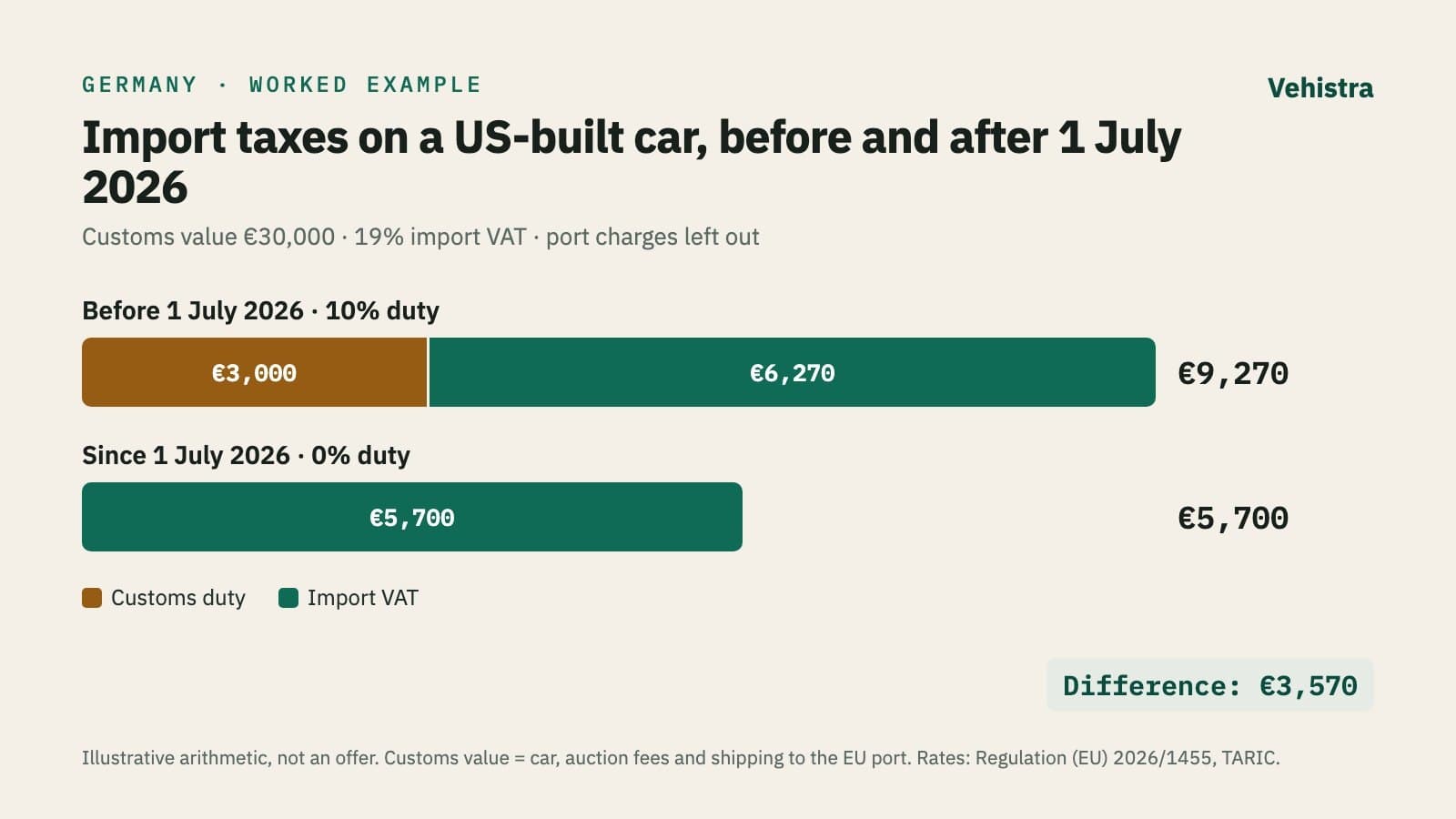
A simplified example for Germany. It leaves out port charges and transport inside the EU, which can also enter the import VAT base. The customs value is €30,000: the car, auction fees and shipping to the EU port.
What customs will ask for
Saying "US origin" on the declaration is not the end of it. Commission Implementing Regulation (EU) 2026/1422 added Article 59a to the customs code rules. Proof of origin must now include evidence that the goods travelled directly from the United States to the EU, or stayed under customs supervision on the way.
The European Commission's questions and answers on Article 59a are explicit on two points that matter for cars:
In practice your customs agent claims the rate with preference code 300 and document code U190. The bill of lading from a US port to an EU port is the core of the direct-transport proof. Transit through another country is allowed if the car stays under customs supervision and is not altered. The evidence must be in hand when the declaration is lodged, not collected afterwards. If the car is built in the US but you cannot show direct transport, the Commission says the 0% rate cannot be applied. Episode 4 of this series goes through the documents one by one.
How long it lasts
Article 8 says the regulation applies from 1 July 2026 until 31 December 2029. Before that date the Commission can suspend it under Article 3, for example if the United States does not implement the August 2025 joint statement. It can also adopt safeguard measures if rising imports cause or threaten serious injury to EU industry (Article 4). Check the rate in TARIC before you bid and again before customs clearance.
How the Vehistra calculator handles it
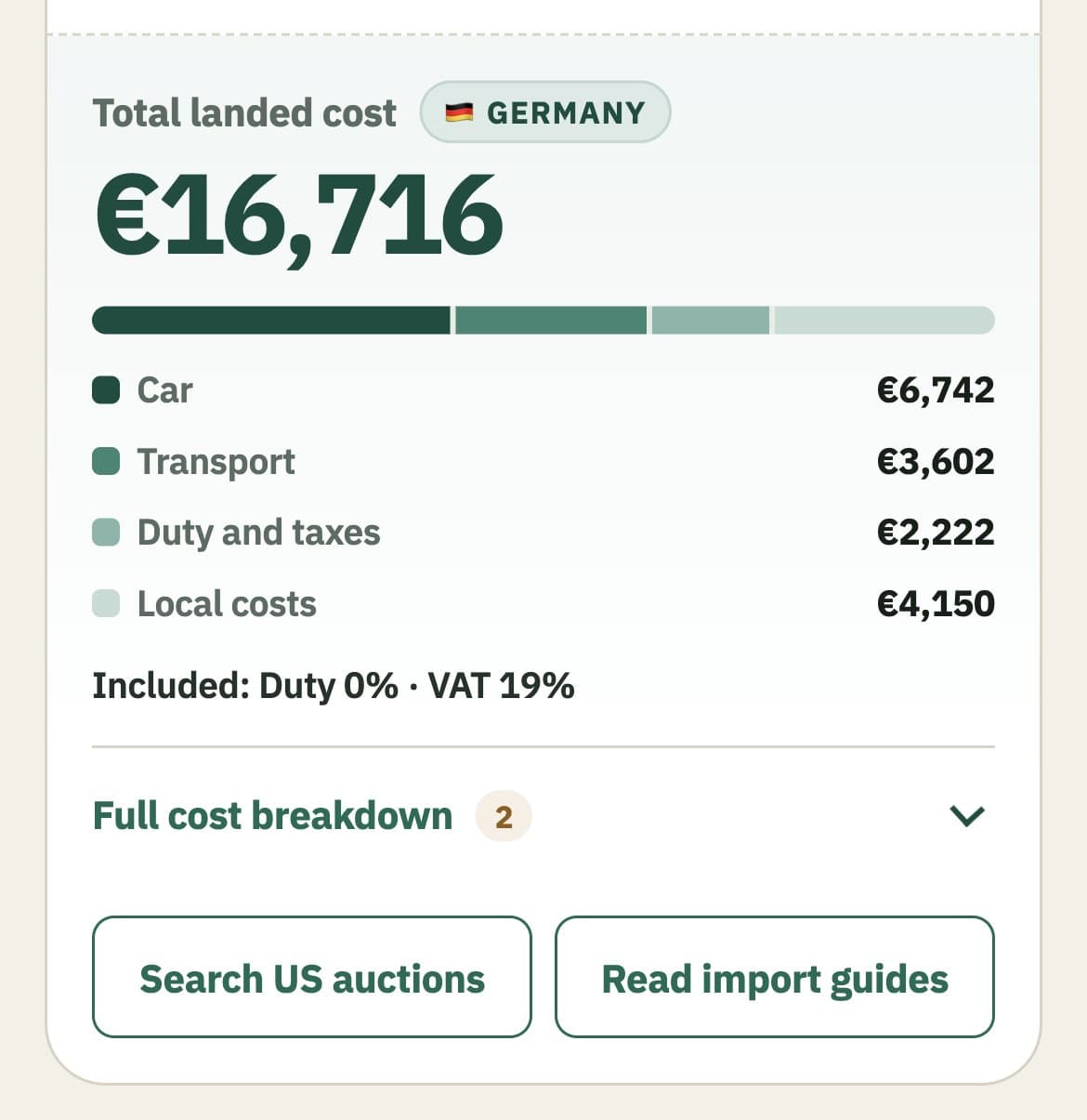
The calculator estimates with 0% duty when the VIN decoder points to a US plant and the destination is in the EU. It uses this car's own bid, fees and shipping, so the numbers differ from the €30,000 example above. For this 2021 BMW X5 with a Spartanburg VIN it shows "Duty 0%" and adds VAT on top. A car built outside the US keeps the 10% line. The VIN is a quick first check, not customs proof: ask your agent to confirm the rate in writing before you bid.