In the Netherlands BPM can erase the saving you see at the auction. This one-off tax, paid before a car gets Dutch plates, follows the CO2 value RDW records for that exact car, so settle that value before you bid. A US car with no accepted CO2 figure can be taxed as if it emitted 550 g/km. Since July 2026 a US-built car can enter at 0% duty, while a new Chinese-made EV carries an extra EU duty but only the minimum BPM.
Duty in 2026: US-built 0% and the extra duty on Chinese EVs
New: 0% duty on US-built cars. Regulation (EU) 2026/1455 of 25 June 2026, Art. 1(1), sets 0% customs duty for goods of US origin listed in Annex I, which covers CN chapter 87 with passenger cars. Under Art. 8 it has applied since 1 July 2026 and runs until 31 December 2029. Origin follows the EU's non-preferential rules (Art. 6): the car has to be manufactured in the US, not just sold there. A Ford Explorer from Chicago can qualify; a Ford Bronco Sport from Mexico bought at a Texas auction cannot. The Commission can suspend the reduced rate under the safeguard in Art. 4, so check the rate on the day of clearance.
For an ordinary passenger car (CN 8703) that does not have US origin, for example one built in Mexico, Canada, Japan, South Korea or China, budget the standard 10% unless another documented preference or relief applies.
How to check where the car was built:
Dutch Customs is explicit: a certificate of origin, a "made in the USA" label or an origin line on the invoice is never enough on its own. The importer collects and keeps the evidence and must be able to show it when customs asks. A car shipped through a third country has to stay under customs supervision there, without processing or alteration beyond the limited handling that Art. 59a of Implementing Regulation (EU) 2015/2447 allows. Budget 10% and treat 0% as a saving once customs has accepted the origin of that car.
Since October 2024: an extra duty on new Chinese-made BEVs. New battery-electric cars made in China pay a countervailing duty on top of the 10%: 17.0% for BYD, 18.8% for Geely, 35.3% for SAIC, 7.8% for Tesla Shanghai, 20.7% for other cooperating producers and 35.3% for the rest. The rate depends on the manufacturing company named in Regulation (EU) 2024/2754 and its TARIC additional code, not on the badge, and it applies only with a commercial invoice carrying the signed declaration the regulation prescribes; without it customs uses the residual 35.3%. The definition follows propulsion, not the sales label: a car driven only by electric motors is covered even with a combustion range extender, while a car whose combustion engine can also drive the wheels, such as a conventional plug-in hybrid, is not. If a producer sells under a price undertaking accepted by the Commission, check whether it covers your channel; a private import does not qualify automatically.
Duty and import VAT at the Dutch border
The examples assume the car is declared to Dutch Customs where it enters the Netherlands, for example in the port of Rotterdam, and is then registered by a private buyer:
BPM: CO2, tariff year and depreciation
Gross BPM in 2026 is calculated from the WLTP CO2 value in g/km: subtract the lower limit of the bracket, multiply by the amount per gram and add the fixed amount.
Diesel passenger cars above 70 g/km add a surcharge of (CO2 − 69) × 114.83 euros. A new fully electric car registered in 2026 falls in the first row and pays the minimum of 687 euros. For a used EV, first pick the tariff year, then deduct depreciation.
A used car gets depreciation on the gross amount. Registration abroad alone does not make a car used: the Belastingdienst looks at actual use and treats a car with 3,000 km or more as used in any case. You may choose the most favourable method: the Belastingdienst flat-rate table (forfaitaire tabel), the latest Dutch price guide (koerslijst), or a valuation report (taxatierapport) by an independent recognised valuer, which is allowed only for a car missing from the price guides or with damage beyond normal wear and tear. The price guide and the valuation compare the Dutch trade purchase value with the historical Dutch new price of a comparable car. The reference date for depreciation is the day RDW completes its inspection, even if you file later.
You may also take the lowest BPM tariff in force between two months before the car's first registration and the RDW approval. The 2023, 2024, 2025 and 2026 tables get dearer each year, so the older one often wins. For a car first registered before 1 July 2020, check which tariff and which CO2 measurement (NEDC or WLTP) you may use, because the rules differ for those cars. A passenger car first registered at least 17 years and 10 months ago owes no BPM, because the flat-rate table then writes the whole amount off.
CO2 evidence for a car without EU type approval. BPM uses the value RDW records. A car with EU type approval has it in the RDW register or on the certificate of conformity (CoC). A US car usually has neither, so the Belastingdienst tariff list names the evidence that counts, in this order: the EU type approval or CoC, an RDW individual approval with the emissions certificate or test report, a test report from an individual test, for example by TNO, or another approval recording the CO2 emissions, provided fuel consumption was measured under UNECE Regulation 101-00. An EPA window sticker or a VIN-decoder estimate is not on that list. If no value can be established, BPM uses 550 g/km for a petrol car and 395 g/km for a diesel first registered from 1 July 2020; for cars first registered between 2015 and mid-2020 the defaults are 507 and 356 g/km, and between 2009 and 2014, 350 and 302 g/km.
Worked examples: US-built 0% next to 10%
Take a customs value of 30,000 euros for a used petrol SUV with an accepted WLTP value of 180 g/km, first registered in the US on 10 March 2023, and assume RDW approves it on 20 November 2026. The flat-rate table gives 57% for 3 years and 6 months plus 0.42% for each of the 3 started months after that: 58.26%. The lowest tariff in the window is the 2023 one: 12,602 euros + (180 − 165) × 488 euros = 19,922 euros gross. BPM = 19,922 × (100% − 58.26%) = 8,315 euros. Duty = customs value × duty rate; VAT = (customs value + duty) × 21%, with no further costs in the VAT base at this stage. Amounts are rounded to the euro; they illustrate the arithmetic with 2026 rules and are not offers:
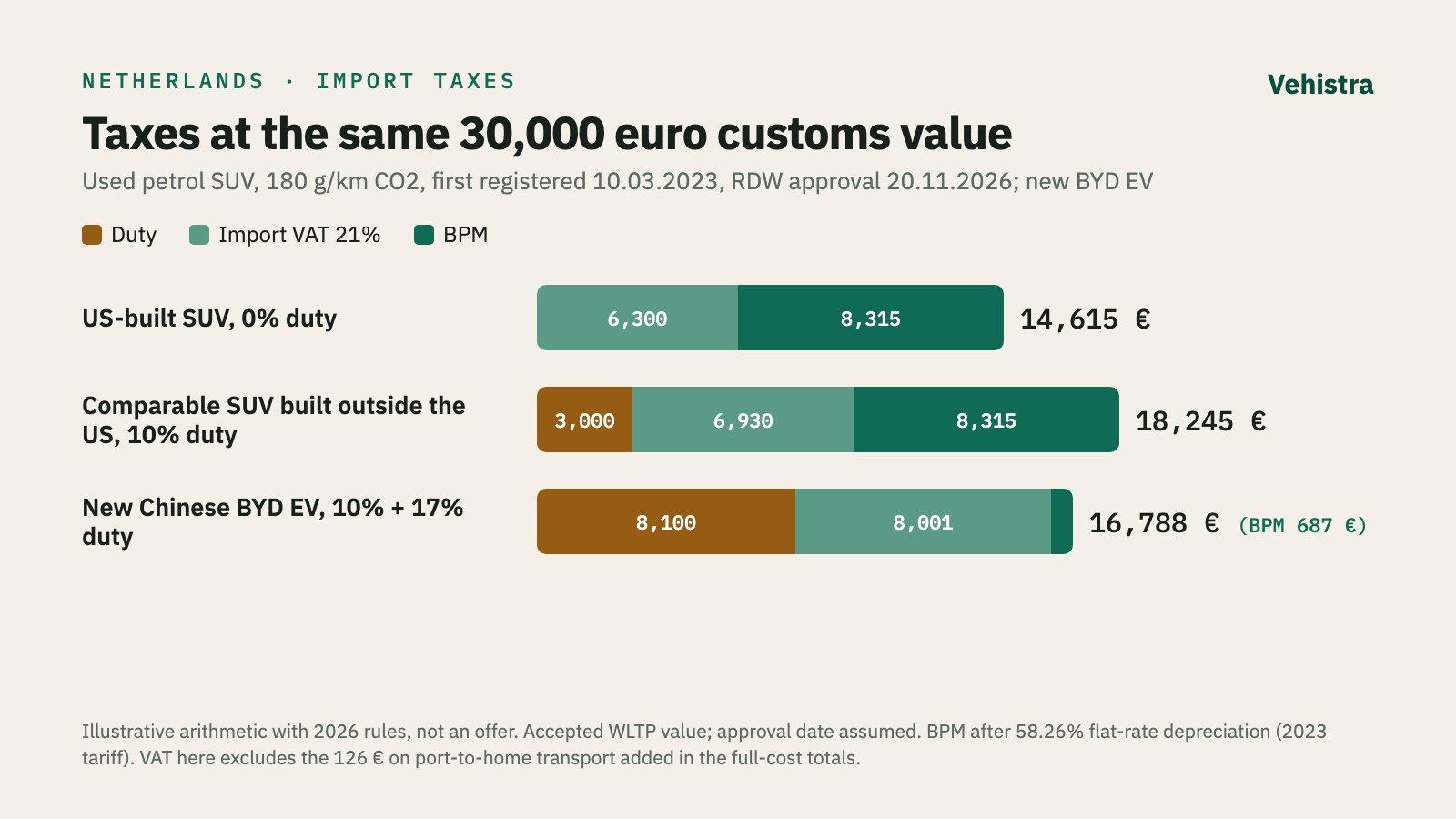
The same US-built SUV without an accepted CO2 value is taxed at 550 g/km: 12,602 + (550 − 165) × 488 = 200,482 euros gross, or 83,681 euros after the same 58.26% depreciation.
When a car already registered in the Netherlands is cheaper
The estimated total cost = customs value + taxes + any buying commission paid separately + costs after clearance + expected repairs + contingency. A buying commission is outside the customs value but belongs in the VAT base; the examples assume none. For the SUV, the costs after clearance are the RDW test in Lelystad (1,128 euros for a car built before 1 January 2024, 1,986 euros for one built later), registration (50 euros), transfer to your name (13.10 euros) and the individual approval certificate (72.50 euros), together 1,263.60 euros. Transport from the port, assumed at 600 euros, belongs in the import VAT base, so count 726 euros.
Add 1,900 euros for conversion work and plates, 3,000 euros of repairs and a 1,000 euro contingency, all as final prices including Dutch VAT. Port handling and a customs agent's fee are not included, so add your own quotes. The SUV built outside the US then costs 30,000 + 18,245 + 7,890 = 56,135 euros, the US-built one 30,000 + 14,615 + 7,890 = 52,505 euros. An undamaged EU-specification BYD with a valid EU CoC goes through the identification route instead: 58.50 euros for identifying the car, 50 euros for the registration certificate, 13.10 euros for the transfer and a 22.50 euro recycling contribution. With the same 726 euros of transport and 200 euros for plates it costs 30,000 + 16,788 + 1,070 = 47,858 euros, to compare with the same version at a Dutch dealer.
A comparable car with Dutch plates is the cheaper choice below those totals. Its BPM was paid when it was first registered and is already in the price, so you file no BPM return. Compare like with like: a repaired auction car and an accident-free local car differ in history, downtime and resale value.
The local car also gives you a test drive and, from a dealer, consumer protection. Under Art. 7:18a(2) of the Dutch Civil Code a lack of conformity that appears within one year of delivery is presumed to have existed at delivery, unless the seller proves otherwise or the nature of the car or of the defect rules that out. Normal wear for the car's age and mileage is not a lack of conformity. A private sale has no such presumption. Check the odometer history with an RDW vehicle report: RDW takes over Belgian readings and, since 3 February 2026, German ones.
Importing from a US auction to the Netherlands
A car that may leave the US is not necessarily a car RDW will approve. Before you bid:
A valuation report can lower the BPM on a damaged car, within limits. The car must have no essential defects that make it unfit for the road; those have to be fixed before the valuation, and the valuer assesses the damage that remains. The loss of value from that damage is set at 31% of the valued repair costs, which lowers the trade value used for depreciation, not the BPM itself. A higher percentage is allowed if the valuer substantiates it, or if the valued amount does not fall below what you paid for the car including Dutch VAT and BPM. Since July 2026 the Belastingdienst checks such returns more closely: the valuation must take place within one month before RDW completes its inspection, and the car must stay unchanged until six working days after the BPM payment. Our US to Netherlands guide covers shipping and customs documents.
Ordering a car from China to the Netherlands
Chinese brands such as BYD sell officially in the Netherlands with EU type approval and a dealer network. A grey import only makes sense if the exact version can be registered, charged, serviced and repaired here. With a valid EU CoC, RDW identifies the car and checks the documents at an inspection station; without accepted type-approval evidence, it normally needs individual approval in Lelystad. Before a deposit, get the CoC for that VIN and variant, check the charging connector and protocol with a demonstrated AC and DC charge, and get in writing who gives the warranty in the Netherlands and whether diagnostics and parts are available. On the tax side a new Chinese-made BEV pays 10% duty plus the countervailing duty and 21% import VAT, then 687 euros BPM under the 2026 tariff. Road tax (MRB) for a fully electric passenger car in 2026 is 70% of the petrol-car rate for the same weight, and the provincial surcharge is charged on that reduced main tax; plug-in hybrids pay the full rate. Our export checklist for new cars from China lists the documents to request.