
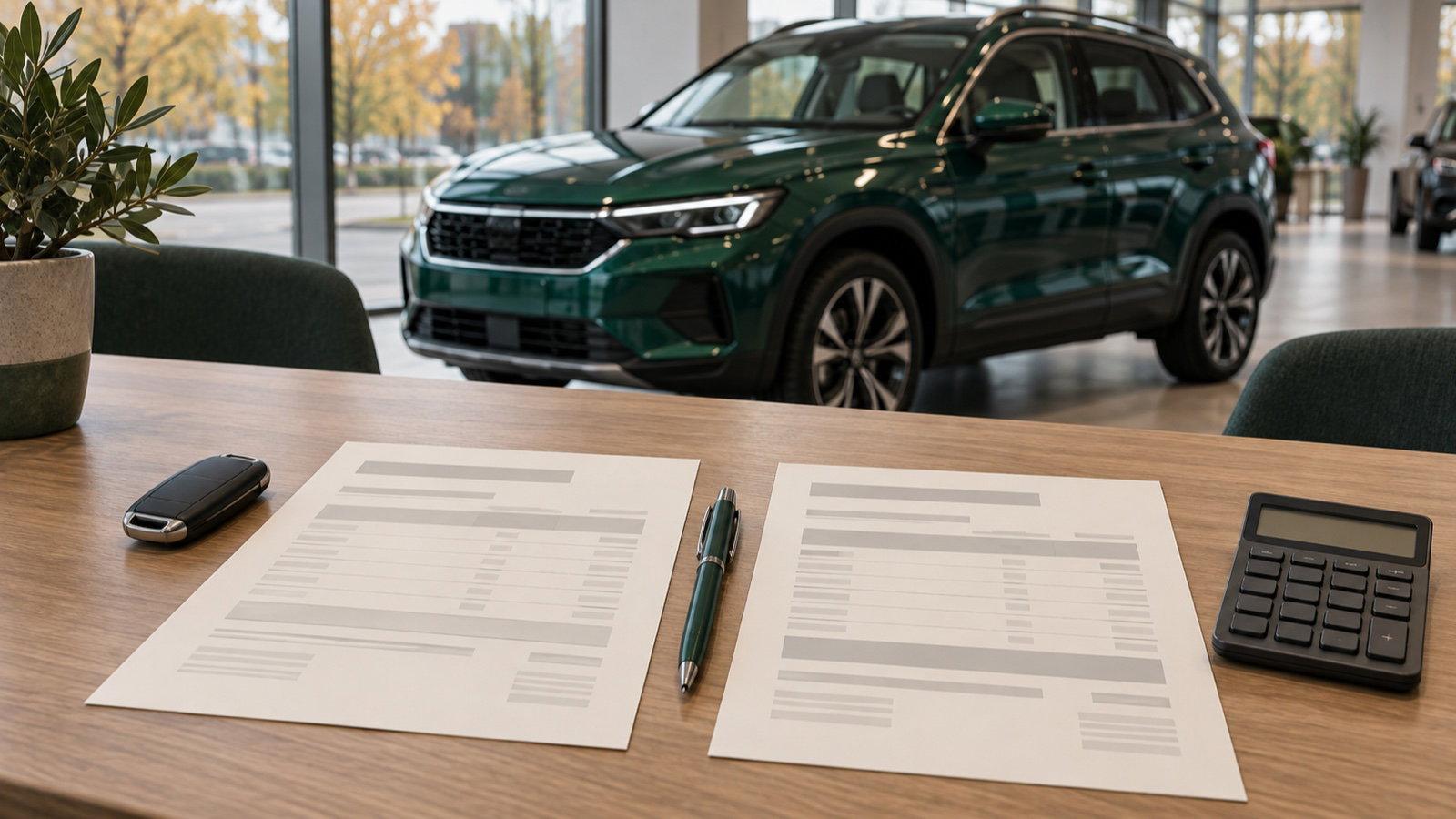
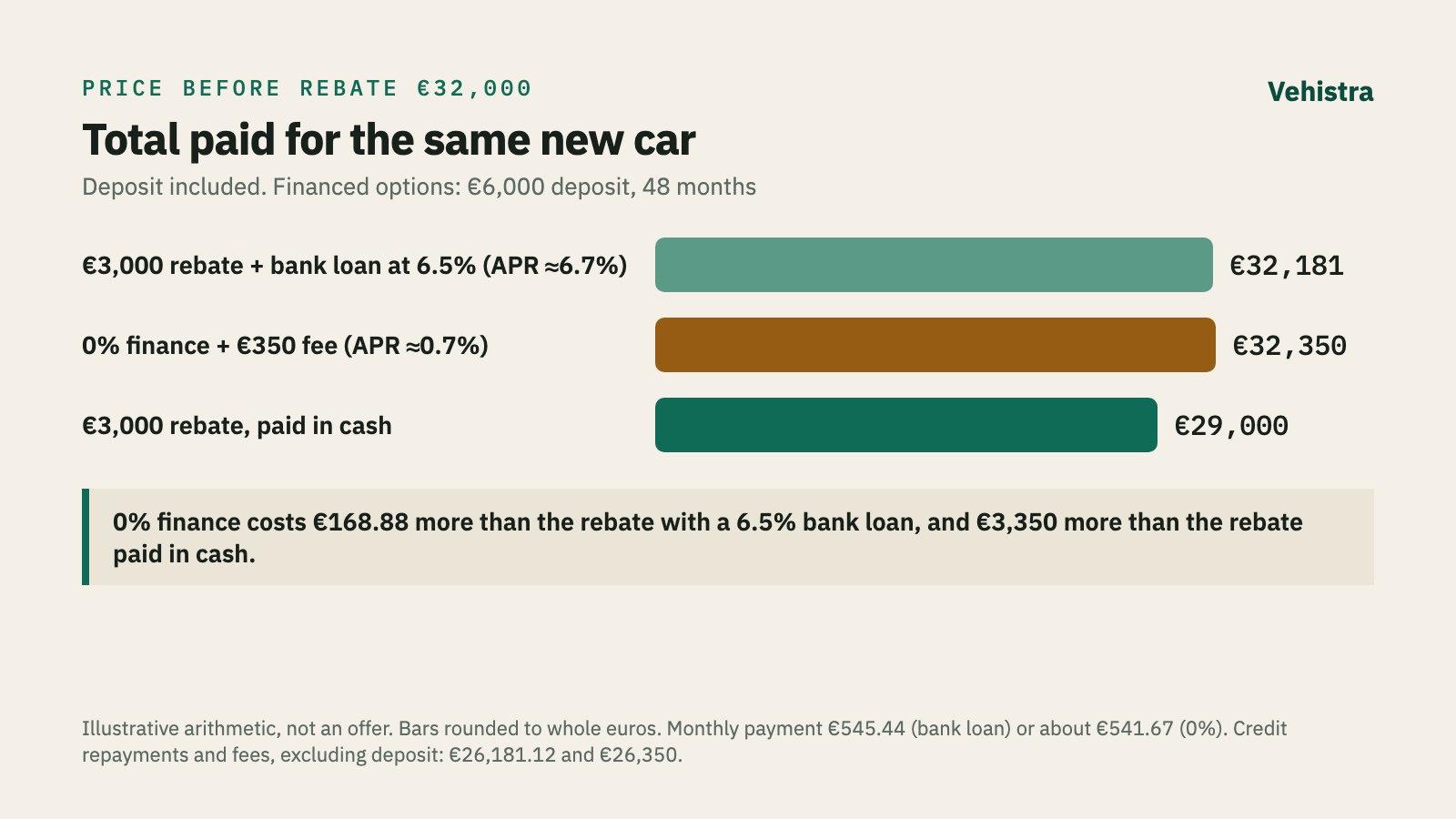
A dealer quotes the same new car two ways: 3,000 euros off the price, or 0% finance at the full price. The monthly payments come out 3.77 euros apart. In our example the 0% offer still costs 168.88 euros more than the rebate with a 6.5% bank loan, and 3,350 euros more than the rebate paid in cash. Below are the numbers, the bank rate at which the result reverses, and what to get in writing before you sign. The arithmetic works in any currency and country. The legal sections describe EU rules as applied through national law: the Consumer Credit Directive 2008/48/EC and its replacement, Directive (EU) 2023/2225, whose national rules apply from 20 November 2026.
Cash rebate versus 0% car finance: a worked example
This is illustrative arithmetic, not an offer from any dealer or lender. The car's price before any rebate is 32,000 euros, and the buyer puts down 6,000 euros either way. Payments are monthly, the first one month after signing, fees are paid upfront, and there is no final balloon payment.
For the bank loans the totals use 48 times the instalment rounded to the cent; a real schedule adjusts the last instalment by a few cents, which moves the totals and the difference by the same amount. Offer B repays exactly 26,000 euros: 47 payments of 541.67 euros and a last one of 541.51 euros. In legal terms, the "total amount payable" on a credit agreement is the credit plus its costs, without the deposit: 26,181.12 euros for the bank loan and 26,350 euros for the 0% offer. The comparison above adds the deposit so that all three options show what leaves your account for the same car.
Why the monthly payment hides the difference
545.44 euros against 541.67 euros. On a dealer's screen those figures look like the same deal, and a monthly figure is easy to steer: a longer term or a larger deposit lowers it without making the car any cheaper. Compare offers only with the same deposit and the same term, and then on two numbers: the total you pay and the APR.
The lender's APR on Offer B is about 0.7%, and that figure is correct for the credit. It does not include the rebate you gave up, because the rebate is not a charge in the credit agreement. Your own comparison has to include it. Against the rebated cash price of 29,000 euros, choosing Offer B means paying 3,350 euros more in exchange for paying 22,650 euros of the price in instalments instead of today. As an annual rate that is about 7.2%, well above the APR on the contract.
The break-even rate: when the rebate wins
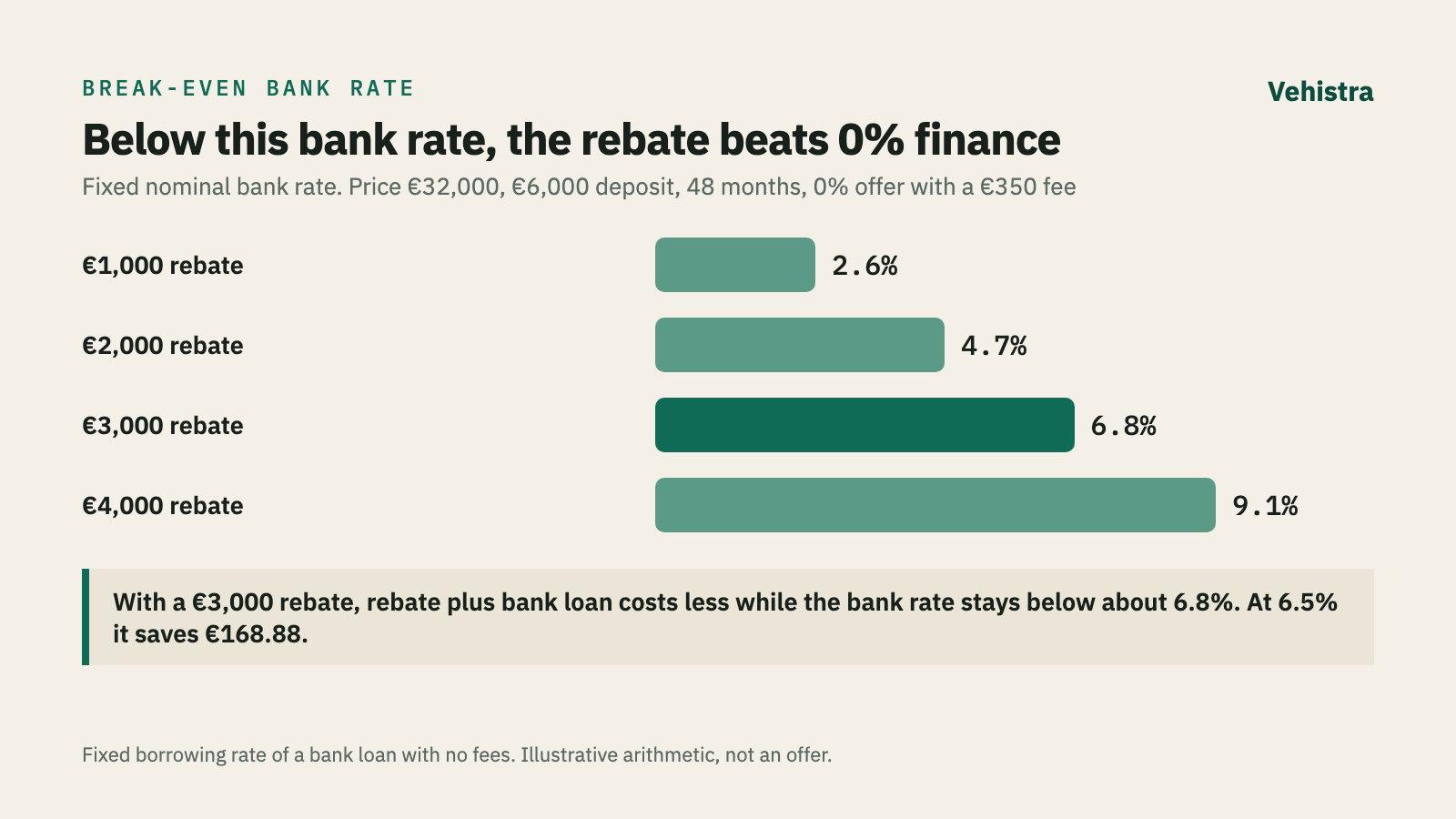
In this example the rebate plus a bank loan costs less as long as the bank's fixed borrowing rate stays below about 6.8%, an APR of about 7% for a loan with no fees. Above that, Offer B costs less. At 6.5% the rebate wins by 168.88 euros. At 8.5% the bank loan would cost 566.91 euros a month, 33,211.68 euros including the deposit, and Offer B would come out 861.68 euros cheaper.
The break-even rate moves with three inputs:
These are fixed nominal borrowing rates. Get a written loan offer from your bank before you visit the dealer, so you know which side of the break-even your own rate falls on.
If you can pay cash
A buyer who has 29,000 euros available can take the rebate and pay in full. Against Offer B that saves 3,350 euros. The usual argument for 0% finance is that your money keeps earning in the meantime. Here, the 22,650 euros you keep back would have to earn about 7.2% a year after tax, while you draw on it for the monthly payments, for all four years. Compare that with a rate you can actually lock in, not with an expected investment return.
Keeping an emergency reserve can justify financing even when it costs more. If paying cash would leave you without a buffer, compare Offer A with a bank loan against Offer B and use the break-even rate above, then decide what the reserve is worth to you.
Can you have the rebate and 0% together?
Promotions often present the rebate and the subsidised rate as alternatives, and the small print decides. Ask for a written price for each way of paying: cash, the dealer's 0% finance and your own bank loan. If the price on the 0% contract is higher than the cash price, choosing the finance raises what you pay for the car by that difference, even though it does not appear in the APR.
Some dealers do the reverse and offer a lower price only if you take their finance. Then compare what you pay in total on their finance with the cash price without that discount. Early repayment can sometimes keep the discount: ask for a written settlement figure for the date you would repay, including any compensation, refunded costs and whether the dealer would reclaim the discount. Directive 2023/2225, Art. 8(8)(b), lets member states prohibit advertising that makes a discount conditional on taking credit. It does not ban such offers as such, and whether your country uses that option depends on its national law.
What the advert and the SECCI must show
These rules come from EU directives applied through national law, for consumer credit within their scope: under 2008/48/EC generally 200 to 75,000 euros of credit, under 2023/2225 up to 100,000 euros. National law can protect more. Under 2008/48/EC, Art. 4, an advert that quotes an interest rate or any cost figure must show clearly and prominently, in a representative example: the borrowing rate and the charges included in the cost of credit, the total amount of credit, the APR, where applicable the duration, for deferred payment on a specific good the cash price and any advance payment, and where applicable the total amount payable and the instalments. If insurance or another service is compulsory to get the credit on the advertised terms and its cost cannot be determined in advance, the advert must state that obligation together with the APR (Art. 4(3)).
In good time before you are bound, the lender must give you the Standard European Consumer Credit Information (SECCI) on paper or another durable medium (Art. 5). The form exists for comparison: ask for one for the 0% offer and one for your bank loan, each for the amount you would actually borrow, and put them side by side with the dealer's written price.
The current directive has a gap. Art. 2(2)(f) excludes credit "granted free of interest and without any other charges", so a 0% deal with no fee at all can fall outside these protections. Offer B, with its 350 euro fee, is within them.
From 20 November 2026 member states apply Directive 2023/2225 (Art. 47 and 48). Being interest-free no longer takes a credit agreement out of scope on its own; a four-year dealer loan like Offer B falls within the rules, subject to the other scope conditions. For credit that is free of both interest and other charges, member states may switch off a few items, such as the cash price and total amount payable in adverts (Art. 2(8)), but the warning stays: adverts must carry "Caution! Borrowing money costs money" or equivalent wording (Art. 8(1)). Wording that creates false expectations about the cost of credit or the total amount payable is prohibited (Art. 7). Fixed-term agreements that exist on 20 November 2026 generally stay under the old rules until they end (Art. 47).
Withdrawal and early repayment
For covered credit the general withdrawal period is 14 calendar days, without giving a reason (2008/48/EC Art. 14; 2023/2225 Art. 26); credit linked to a purchase can have special rules. The period runs from the conclusion of the agreement, or from when you receive the contract terms and the required information, whichever is later. Send the notice in the way the contract specifies and keep proof. You then repay the capital, with interest at the agreed borrowing rate, without delay and no later than 30 days after sending the notice; on a 0% loan that interest is nothing. Ancillary services the lender arranged with the credit end too. Withdrawing from the credit does not automatically cancel the purchase of the car; that depends on national law and the sale contract, so ask before you rely on it.
You may repay early at any time, and the cost of the credit falls for the remaining period (2008/48/EC Art. 16; 2023/2225 Art. 29, which counts all costs the lender imposed). During a fixed-rate period the lender can ask for fair compensation, normally capped at 1% of the amount repaid if more than a year remains and 0.5% otherwise; national law can allow more where the lender proves a larger loss. In every case compensation cannot exceed the interest you would have paid for the remaining period (Art. 16(5); Art. 29(5)). At a 0% borrowing rate that cap is zero. This matters if you sell the car before the last instalment.
Add-ons that change the comparison
Read the 0% offer for anything tied to it:
Under 2008/48/EC, Art. 3(g), the cost of an ancillary service, in particular insurance, counts in the total cost of credit if that contract is compulsory to obtain the credit or the advertised terms and the lender knows the cost. Ask which items are optional and get a separate price for each. For your own comparison between the offers, count only the extra cost: if you would insure the car comprehensively anyway, compare the dealer's policy with the same cover from your own insurer, not with no insurance. That does not change which compulsory costs the lender must include in the APR.
From 20 November 2026 the new directive prohibits tying, where the credit is not available without other financial products, and allows bundling, where it is (Art. 14(1)). Member states may still let lenders require certain accounts or insurance. Where a lender requires insurance, it must accept an equivalent policy from another insurer without changing the credit terms (Art. 14(3)), you get at least three days to compare insurance offers while they stay unchanged, unless you expressly ask to take out the policy sooner (Art. 14(5)), and your consent cannot come from pre-ticked boxes (Art. 15).
Balloon payments, PCP and leasing
A balloon plan lowers the monthly payment by leaving a large final payment. Personal contract purchase (PCP) is a common name for a balloon plan with the option to hand the car back instead of paying the balloon, usually within mileage and condition limits. Compare two outcomes separately: keeping the car, where the balloon and any purchase fee belong in the total; and returning it, where excess-mileage and damage charges do, and you end up without a car. When a 0% offer is built this way, check whether the 0% also covers the final payment, who owns the car during the agreement, and whether refinancing the balloon needs a new application at a new rate.
Leasing works differently. Under 2008/48/EC, Art. 2(2)(d), a lease without an obligation to purchase is outside the directive. Directive 2023/2225 limits that exclusion to leases with neither an obligation nor an option to purchase (Art. 2(2)(g)), so a lease with a purchase option is no longer excluded on that ground. A lease that ends with returning the car never makes the car yours; compare it with the depreciation and finance cost of owning the same car for the same period and mileage, not with the instalments of a loan.
Deadlines: order, registration and delivery
Promotions end on a date, and the date can refer to the order, the signed credit agreement, registration or delivery. If the car is built to order and delivery slips past the end of the promotion, find out whether the 0% rate and the rebate still apply. Get the deadline in writing, together with how long the credit approval is valid and when a deposit is refunded. A car the dealer registered before the sale to meet a target can carry a lower price, but the warranty may already be running and you may be entered as the second keeper. Check both before you sign.
What to ask for in writing
Comparing your cash price with an import
Once you know the cash price, you can compare it with a car of the same specification and condition bought elsewhere, delivered and registered. Since 1 July 2026 cars of US origin can enter the EU at 0% customs duty under Regulation (EU) 2026/1455. Origin follows the EU's non-preferential rules: the car has to be manufactured in the US, not just sold there, it has to be shipped directly to the EU or stay under customs supervision while passing through another country, and customs must accept the proof of origin and transport. Import VAT and, where your country has one, registration tax still apply. The import cost calculator estimates duty, VAT and fees for your country, and our guide to calculating landed cost before you bid lists the costs to include.