

Episode 1 of this series showed the rule: since 1 July 2026 a car built in the United States enters the EU at 0% customs duty instead of 10%. This episode is the money. The short version: you save more than 10% of the customs value, because in every EU country duty sits inside the base of the taxes charged after it. The examples assume a private buyer clears the car in the country shown; clearing it in another EU country needs a separate calculation. The rate applies from 1 July 2026 to 31 December 2029, unless it is suspended earlier.
Why the saving is bigger than 10%
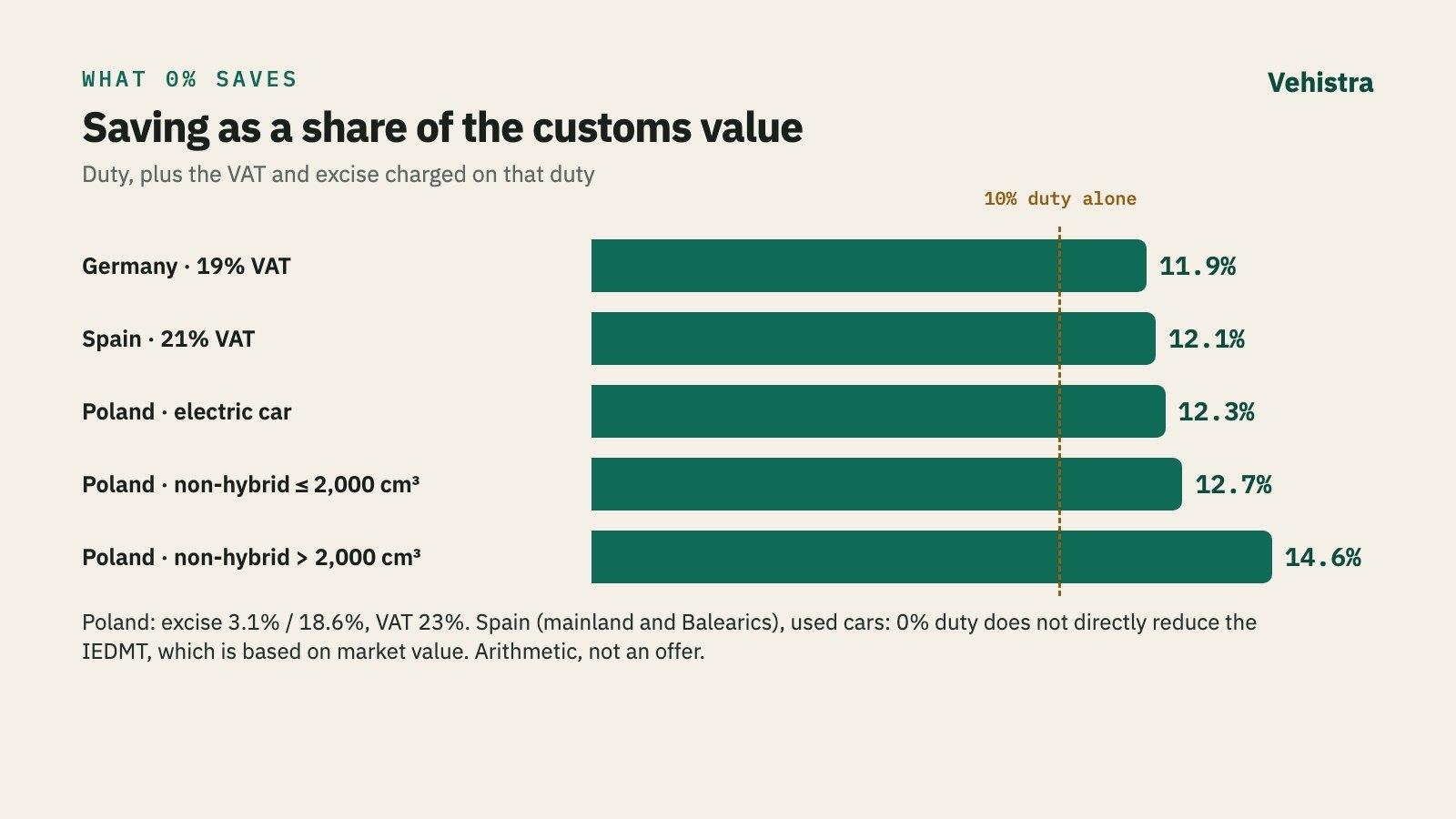
Import VAT is charged on the customs value plus duty. Remove the duty and the VAT base shrinks too. In Poland excise is also charged on the customs value plus duty, and VAT is then charged on top of excise. So 10% duty has always cost more than 10%:
That is the share of the customs value a US-built car no longer pays. In these examples the customs value is the purchase price, the auction charges that count for customs valuation, and transport and insurance to the EU border.
Germany: €25,000 customs value
Germany has no purchase tax on cars, so that is the whole difference at the border. Registration and annual Kfz-Steuer stay the same.
Spain: €25,000 customs value (mainland and Balearics)
The registration tax (IEDMT) is separate. For a used car it is charged on the vehicle's market value, not on the customs value plus duty, so the 0% rate does not change it. Its rate depends on CO2 emissions; an electric car pays 0%.
Poland: 100,000 zł customs value
Here the engine decides, because excise depends on it and is charged on the duty.
Hybrids work differently. Hybrids up to 2,000 cm³ pay 1.55% excise; hybrids, including plug-ins, over 2,000 and up to 3,500 cm³ pay 9.3%, and above that 18.6%. Plug-in hybrids up to 2,000 cm³ are exempt until 31 December 2029. Zero duty lowers excise only where excise is due.
A real lot: 2016 Jeep Grand Cherokee from Detroit
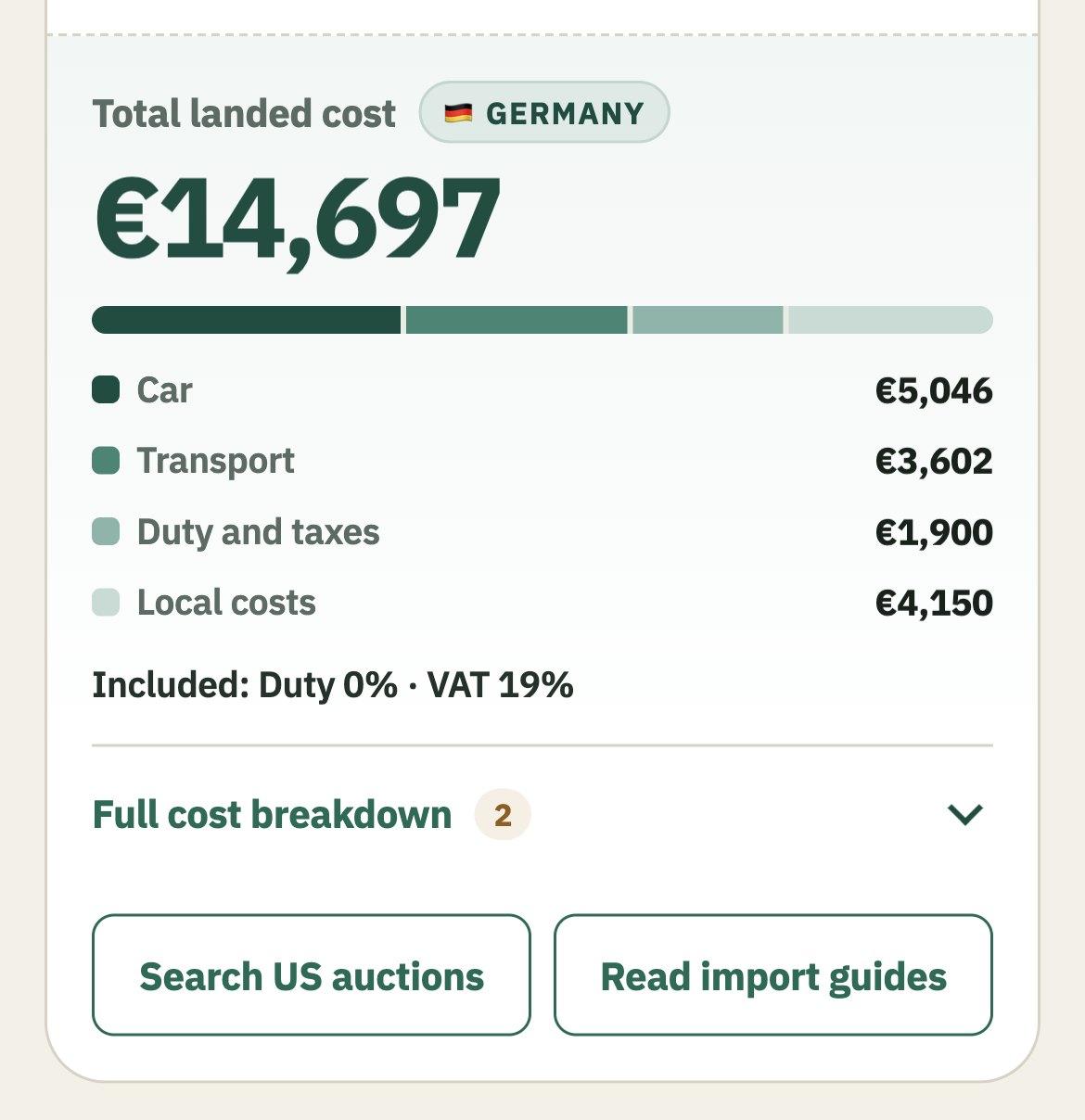
This Grand Cherokee (VIN 1C4RJFBG9GC454841, 3.6-litre V6 petrol, rear-end damage) sold at Copart on 2 July 2026 for $5,800; NHTSA decodes its VIN to Detroit, Michigan. With 0% duty the Vehistra calculator estimates the import at 58,547 zł in Poland (18.6% excise for a non-hybrid engine over 2,000 cm³, 23% VAT), €14,697 in Germany and €16,173 in Spain. The Spanish total includes an IEDMT placeholder of about €1,276, 14.75% of the customs value; the real base is the car's market value, so treat that line as unconfirmed.
The calculator combines the recorded sale price with default estimates for auction fees, shipping and local costs. The local costs are a flat allowance with repairs set to zero, not a quote for the rear-end damage, so these totals are not a tax-only comparison with the round examples above. The calculator takes 0% from the decoded plant; the VIN alone does not prove origin, so customs will still want origin and transport documents. With the same inputs and 10% duty instead of 0%, duty and the taxes charged on it would add about 5,409 zł in Poland, 14.6% of this lot's customs value of 37,076 zł, about €1,029 in Germany and about €1,046 in Spain, with IEDMT unchanged.
What these examples leave out
The round examples skip port charges, transport inside the EU, registration and repairs. Some of those costs also enter the import VAT base. And the 0% rate needs proof of US origin and direct transport, which episode 4 covers. Use the numbers to see what the rule is worth, then price a specific car in the calculator and let a customs agent confirm it.