

Germany has a deep used-car market, so an import has to beat a strong local alternative. A US auction car looks cheap at the hammer price and a Chinese electric car looks cheap on a Chinese price list. In Germany both go through customs and usually pay import VAT, the duty depends on where the car was built, and a used US car usually needs an individual approval before it gets plates. This guide gives the 2026 rates, worked examples and the break-even price for a car already registered in Germany.
Import rules for Germany in 2026
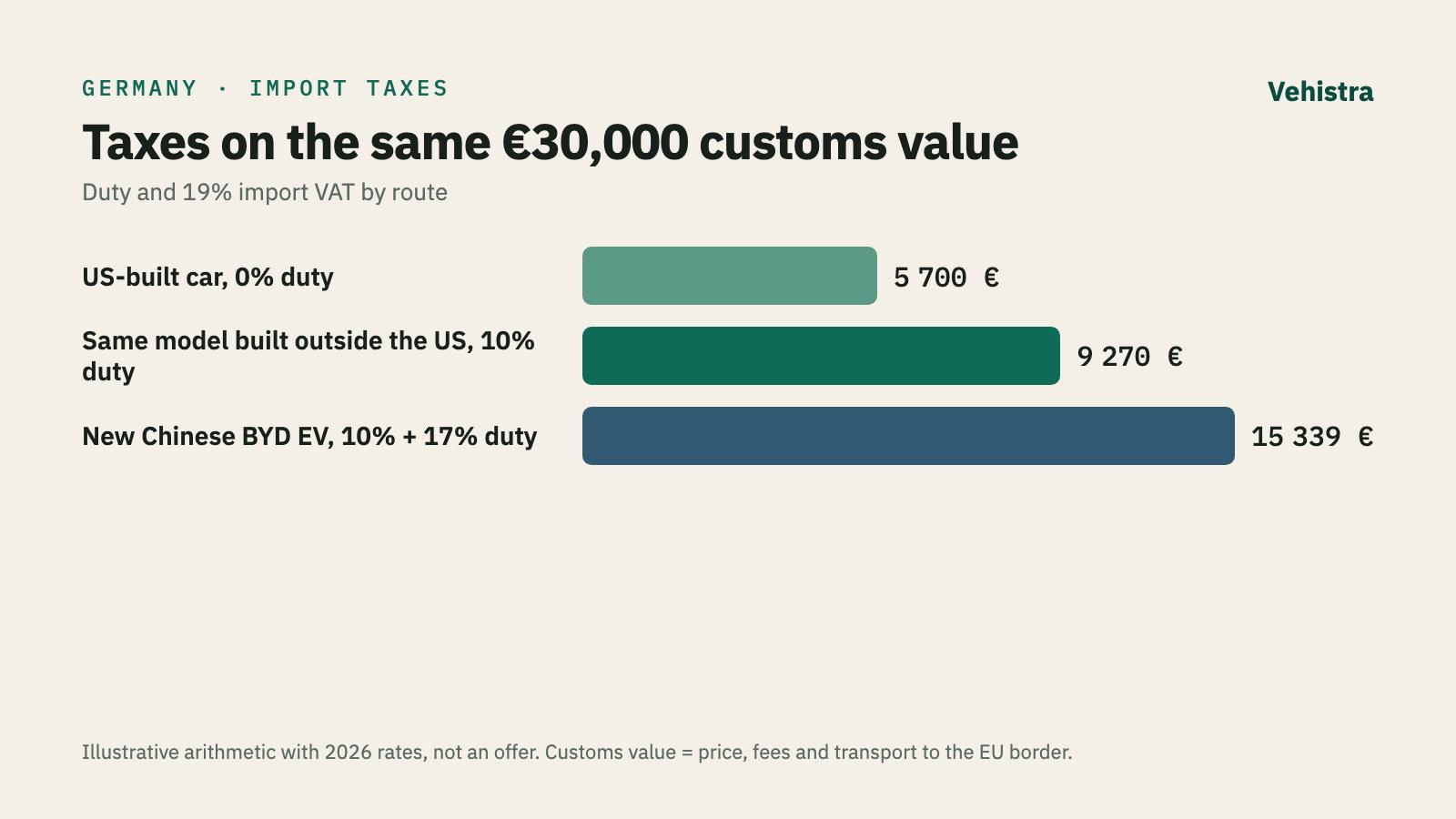
New: 0% duty on US-built cars. Regulation (EU) 2026/1455 of 25 June 2026, Art. 1(1), sets 0% customs duty for goods of US origin listed in Annex I, which covers CN chapter 87 with passenger cars. Under Art. 8 it has applied since 1 July 2026 and runs until 31 December 2029. Origin follows the EU's non-preferential rules (Art. 6): the car has to be manufactured in the US, not just sold there. A BMW X5 from Spartanburg, South Carolina can qualify; a BMW 3 Series from Munich bought at a US auction cannot. The Commission can suspend the reduced rate under the safeguard in Art. 4, so check the rate on the day of clearance.
For an ordinary passenger car (CN 8703) that does not have US origin, for example one built in Mexico, Canada, Japan, China or the EU, budget the standard 10% unless another documented preference or relief applies. Being built in the EU does not in itself give returned-goods relief.
How to check where the car was built:
Customs can ask for proof, and the importer carries the burden of showing it. Dutch Customs, as an example of practice in a neighbouring member state, says a certificate of origin, a "made in the USA" label or an origin line on the invoice is never enough on its own. A broker's confirmation does not bind customs. Budget 10% and treat 0% as a saving once customs has accepted the origin of that car.
Since October 2024: an extra duty on new Chinese-made BEVs. New battery-electric cars made in China pay a countervailing duty on top of the 10%: 17.0% for BYD, 18.8% for Geely, 35.3% for SAIC, 7.8% for Tesla Shanghai, 20.7% for other cooperating producers and 35.3% for the rest. The producer rate needs the required invoice declaration and the right TARIC code; without them customs uses the residual rate. The definition is based on propulsion: cars driven only by electric motors are covered even with a combustion range extender. Since 2026 an import made under a price undertaking accepted by the Commission can be exempt, but only for that producer's approved sales channel, not for any private import of the same model.
How duty and import VAT add up in Germany
The examples assume the car is cleared in Germany. Germany has no extra excise on passenger cars and no registration tax:
A private buyer bears the import VAT. A business can deduct it only if it meets the conditions of §15 UStG for that car, so the examples below are for a private buyer.
Worked examples: US-built 0% next to 10%
Take a customs value of 30,000 euros for a passenger car, with no further incidental costs. The formulas: duty = customs value × duty rate; import VAT = (customs value + duty) × 19%. These illustrate the arithmetic with 2026 rates and are not offers:
When a car already registered in Germany is cheaper
The estimated total cost = customs value + taxes + any buying commission paid separately + costs after clearance + expected repairs + contingency. A buying commission is outside the customs value but belongs in the import-VAT base; the examples assume none. In these examples the costs after clearance are ones outside the import-VAT base: transport ordered after clearance, conversion, the expert report and registration. If part of them belongs in the base, add 19% of that part.
Assume 3,500 euros for those, a 3,000 euro repair estimate and a 1,000 euro contingency; use your own quotes. The car built outside the US then costs 30,000 + 9,270 + 7,500 = 46,770 euros, the US-built one 30,000 + 5,700 + 7,500 = 43,200 euros. An undamaged EU-specification BYD with a valid EU CoC needs no repairs or conversion; with 2,000 euros after clearance it costs 30,000 + 15,339 + 2,000 = 47,339 euros, to compare with the same version's price at a German dealer.
A comparable car already registered in Germany has the lower estimated cost below those figures. A private sale carries no separate tax on the contract; for a dealer, compare the final consumer price, which may come from the margin scheme without separately shown VAT. Compare like with like: a repaired auction car and an accident-free local car differ in history, downtime and resale value.
The local car also gives you a test drive and, if you buy as a consumer from a dealer, a two-year limitation period for defect claims. For a used car the dealer can shorten it to one year, but only if you were told beforehand and agreed expressly and separately (§476 BGB). A manufacturer warranty is a separate promise. Ask for the service records rather than assuming a German car has a complete history.
Importing from a US auction to Germany
A title that can leave the US is not automatically a car Germany will register. Before you bid:
Our US to Germany guide covers shipping and customs documents.
Ordering a car from China to Germany
Many Chinese brands sell officially in Germany with EU type approval, a dealer network and a warranty. A grey import can still make sense for price, specification or a model not sold here, but only if the exact version can be registered, serviced and repaired. Before a deposit, get the CoC or type-approval evidence for that VIN and variant, check the charging connector and protocol with a demonstrated AC and DC charge, and get in writing who gives the warranty in Germany and whether diagnostics and parts are available. Our export checklist for new cars from China lists the documents to request.
From the port to German plates
Annual vehicle tax depends on the car's original first-registration date, including registration abroad: for passenger cars first registered from 1 July 2009 it is based on engine capacity and CO2, for older cars on capacity and emission class. Electric cars first registered between 18 May 2011 and 31 December 2030 are exempt for up to ten years, at the latest until 31 December 2035; the exemption is granted once per car and does not restart with a new owner, so a used import gets only the remaining period.
A car at least 30 years old, in original condition, of a model no longer produced and of historical interest can be classified by customs as a collector's item (CN 9705): no duty and 7% import VAT. That customs classification is separate from the H-plate assessment for historic registration.