
Since 1 July 2026 a car of US origin enters the EU at 0% customs duty. Buying at a US auction does not establish US origin. What counts is where the car was made, not the auction yard, the seller's address or the state that issued the title. The rate applies from 1 July 2026 to 31 December 2029, subject to suspension or safeguard measures, and import VAT and national taxes still apply. Here is how to tell the difference with real VINs from the Vehistra archive.
Origin means the factory
Article 6 of Regulation (EU) 2026/1455 uses the non-preferential origin rules of the Union Customs Code. Under Article 60 of the Code, a product made with parts from several countries originates where it underwent its last substantial processing. For a car, final assembly normally identifies the likely country of origin, and the manufacturing documents have to back it up.
Where the car was sold, registered, or crashed does not change that. A car built in Ontario and driven in Texas for ten years is still Canadian for EU customs.
Same auction, different factories
We decoded VINs of cars sold at Copart and IAAI with the NHTSA vPIC decoder on 1 November 2026:
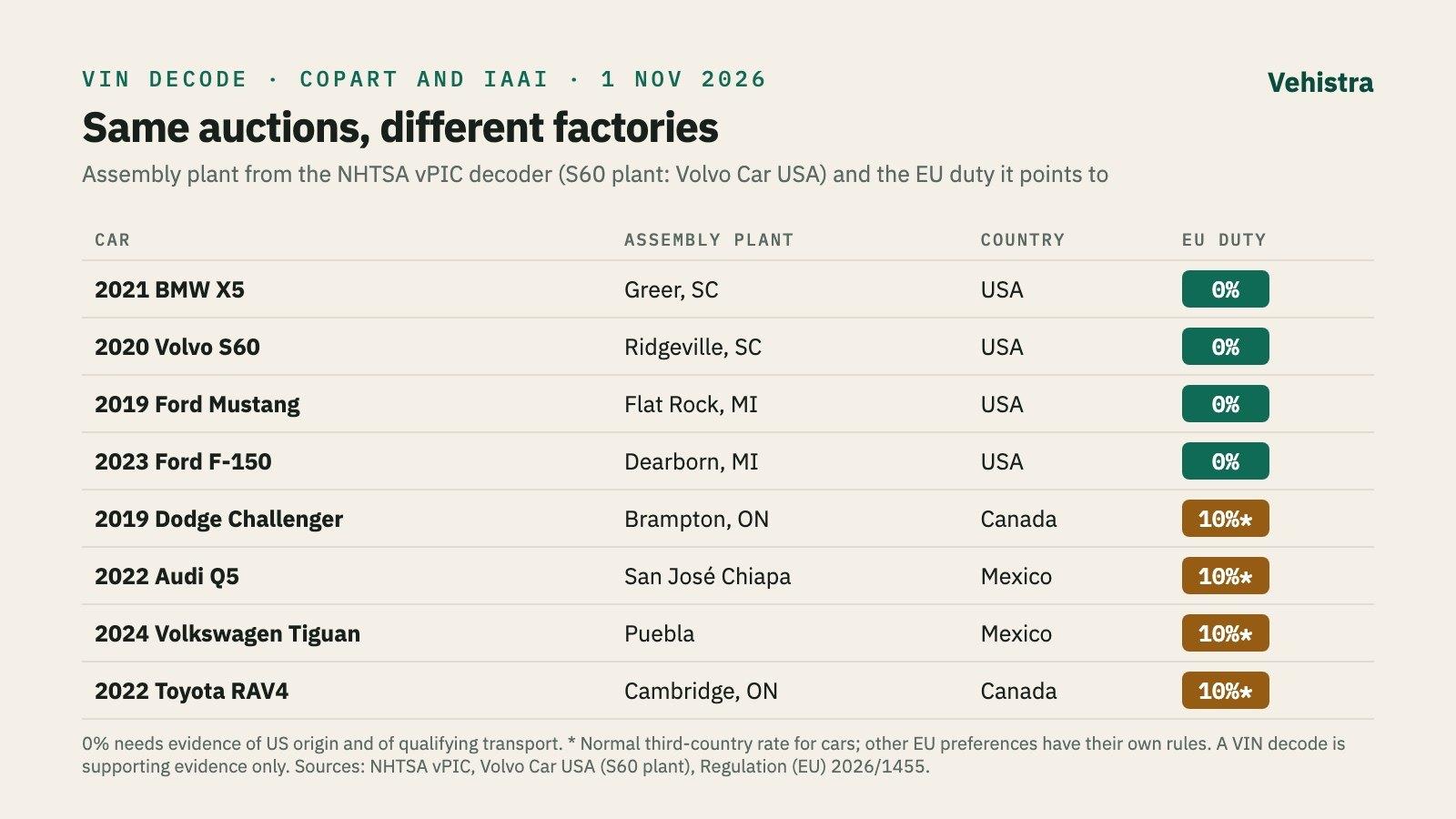
Two lessons sit in that list. A European brand can be American for customs: the X5 and the S60 above were assembled in the US. And an American brand can be Canadian: this Dodge Challenger came from Brampton, Ontario, while the Ford Mustang above was built in Flat Rock, Michigan. US assembly is the first check; 0% also needs proof of origin and direct transport.
One model, three countries
The Chevrolet Equinox shows why you check each car, not each model. Three Equinox VINs from the same archive decode to Tennessee (2015, 1GNALBEK1FZ130964), Ingersoll, Ontario (2017, the CAMI plant, 2GNFLFEK6H6273856) and Ramos Arizpe, Mexico (2023, 3GNAXTEG0PS198595). Honda's CR-V has come from Indiana, Ohio, Ontario and Japan. The RAV4 has been built in Kentucky, Ontario and Japan. Only the US-built ones get 0%; the others normally pay 10%.
What the VIN tells you and what it does not
Read the full VIN, not just its first character. The opening characters identify the manufacturer, not always the plant: this Audi Q5 has a WA1 prefix, yet NHTSA gives its assembly plant as San José Chiapa, Mexico.
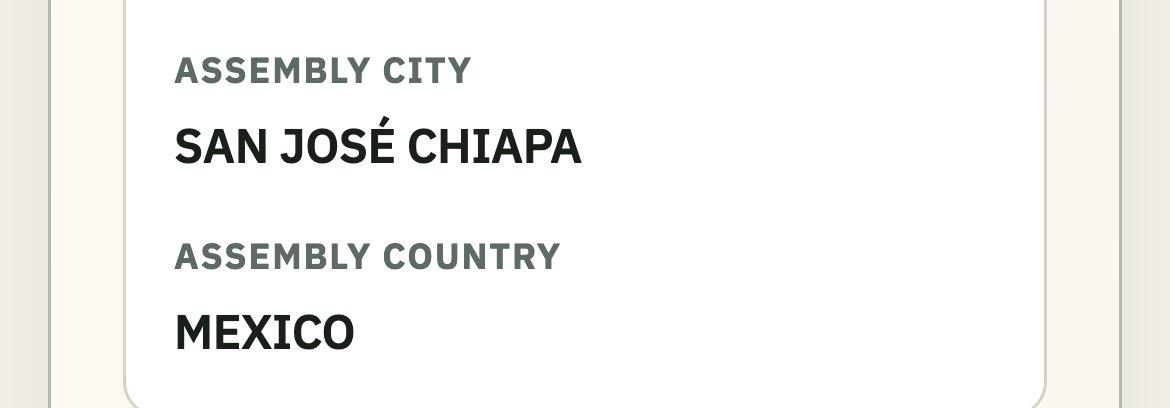
The plant code inside the VIN, read by a decoder, is a better signal. Vehistra's VIN check shows it as assembly city and country. Even so, the European Commission's Q&A on Article 59a is clear: a decoded VIN is not sufficient proof of origin. It supports other documents, such as the original window sticker, which names the final assembly point, or a manufacturer build record.