
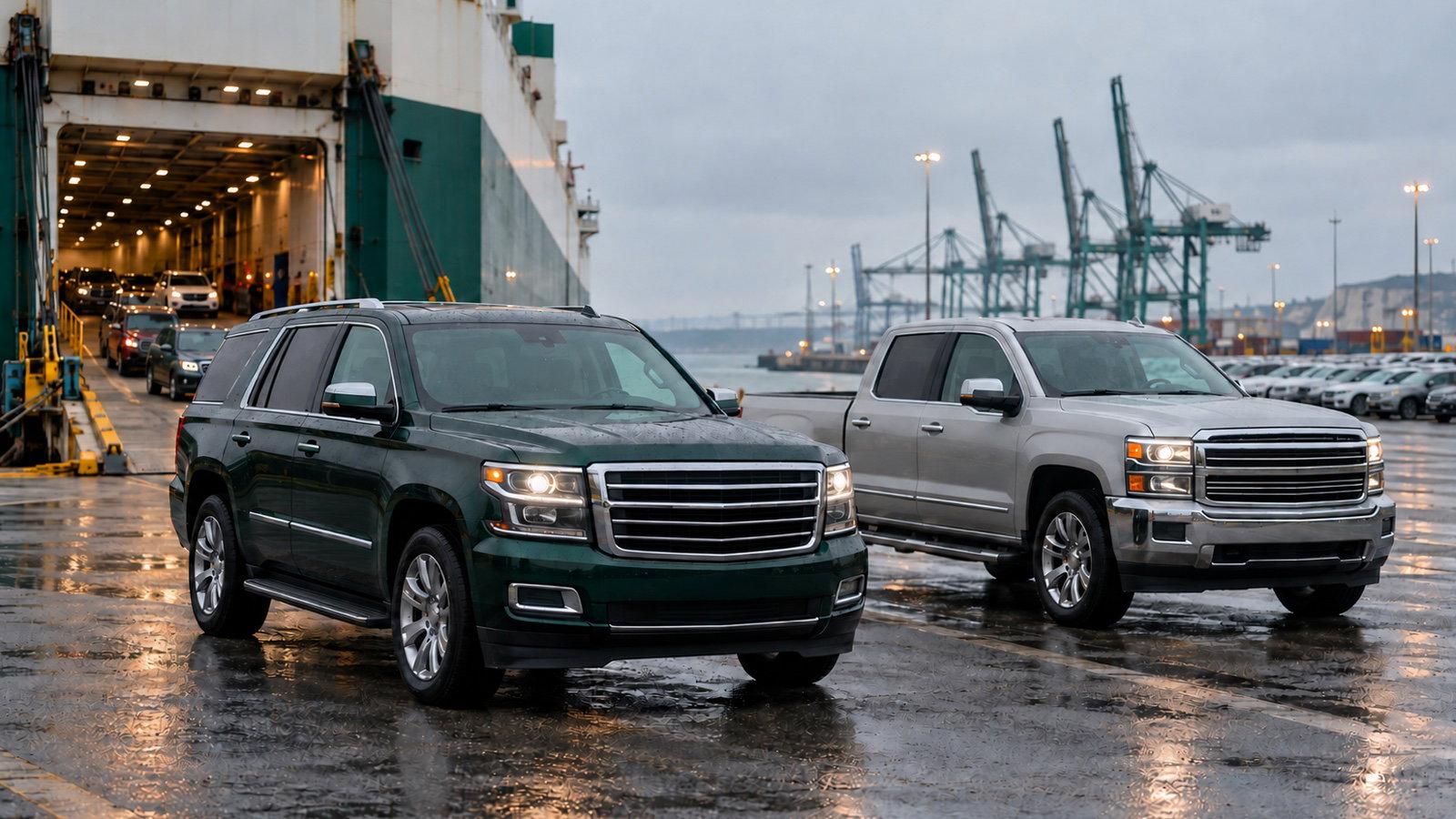
For a car bought outside the EU and registered in metropolitan France, work out the customs charges and the registration taxes separately. Customs collects duty and 20% import VAT. The first French registration then adds the malus, a one-off tax on CO2 or on the fiscal rating (CV, the French administrative horsepower, which is not the engine's actual horsepower) and on weight. For a recent petrol car without European approval it can exceed the duty and VAT together: in the SUV example below, the 3,600 euro saving from the 0% US duty is far smaller than the 22,511 euro malus. This guide gives the 2026 rates, worked numbers for a US-built car, a non-US car and a Chinese electric car, and the price at which a car already registered in France is the better buy.
Import rules for France in 2026
New: 0% duty on US-built cars. Regulation (EU) 2026/1455 of 25 June 2026, Art. 1(1), sets 0% customs duty for goods of US origin listed in Annex I, which covers CN chapter 87 with passenger cars. Under Art. 8 it has applied since 1 July 2026 and runs until 31 December 2029. Origin follows the EU's non-preferential rules (Art. 6): the car has to be manufactured in the US, not just sold there. A Toyota Camry from Kentucky can qualify; a Toyota from Japan bought at a Texas auction cannot. The Commission can suspend the reduced rate under the safeguard in Art. 4, so check the rate on the day of clearance. Since July 2026 the proof of origin must also show direct transport to the EU (Art. 59a of the Union Customs Code implementing rules): if the car passes through a third country, it has to stay under customs supervision there and must not be altered other than to preserve it or to add marks, labels, seals or documents required for compliance, and the evidence has to be available when the 0% rate is claimed.
For an ordinary passenger car (CN 8703) that does not have US origin, for example one built in Mexico, Canada, Japan, China or the EU, budget the standard 10% unless another documented preference or relief applies. French customs warn that duty can reach 22% for some pickups and mixed-use vehicles with a load bed, depending on engine size and weight; a US-built pickup in those headings also falls to 0% with accepted origin.
How to check where the car was built:
The Commission's guidance on the new rules says a decoded VIN is not sufficient proof of origin, and a "made in USA" label or an origin line on the invoice is not enough on its own. Budget 10% and treat 0% as a saving once customs has accepted the origin of that car.
Since October 2024: an extra duty on new Chinese-made BEVs. New battery-electric cars made in China pay a countervailing duty on top of the 10%: 17.0% for BYD, 18.8% for Geely, 35.3% for SAIC, 7.8% for Tesla Shanghai, 20.7% for other cooperating producers and 35.3% for the rest. The producer rate needs the required invoice declaration and the right TARIC code; without them customs uses the residual rate. Cars driven only by electric motors are covered even with a combustion range extender. Conventional plug-in hybrids are outside the measure and pay the 10% duty. An import made under a price undertaking accepted by the Commission can be exempt from the countervailing duty, but only through that producer's approved sales channel.
Carte grise cost in France: regional tax and malus
The examples assume a private buyer and a car cleared in France, for example at Le Havre:
For a car registered new in France in 2026, the CO2 malus starts at 50 euros at 108 g/km and reaches 80,000 euros above 191 g/km. In the 2026 horsepower grid, 5 CV costs 4,750 euros, 8 CV 15,250 and 11 CV 36,000. The weight malus starts at 1,500 kg: 10 euros per kg from 1,500 to 1,699 kg, 15 to 1,799, 20 to 1,899, 25 to 1,999 and 30 from 2,000 kg. CO2 malus plus weight malus cannot exceed the top rate of the CO2 grid that applies, 80,000 euros for 2026. Pure battery-electric and hydrogen cars are exempt from both. For a 2026 first registration, a plug-in hybrid with more than 50 km of electric city range has 200 kg (at most 15% of its mass) deducted before the weight malus is calculated, other hybrids 100 kg.
Selected regional rates per CV in 2026, as listed by Service-Public: 43 euros in Auvergne-Rhône-Alpes and in Hauts-de-France (from 1 April), 51 in Pays de la Loire, 58 in Nouvelle-Aquitaine, 59.50 in Occitanie, 60 in Brittany, Normandy, Grand Est and Provence-Alpes-Côte d'Azur, and 68.95 in Île-de-France including a transport surcharge. For a new electric car only Hauts-de-France still reduces the rate, by half from 1 April 2026; elsewhere it pays the ordinary rate. A car first registered at least ten years earlier pays half the regional rate. The rate is that of the region where the owner lives, not where the car was cleared.
Worked examples: US-built at 0%, non-US at 10% and a Chinese EV
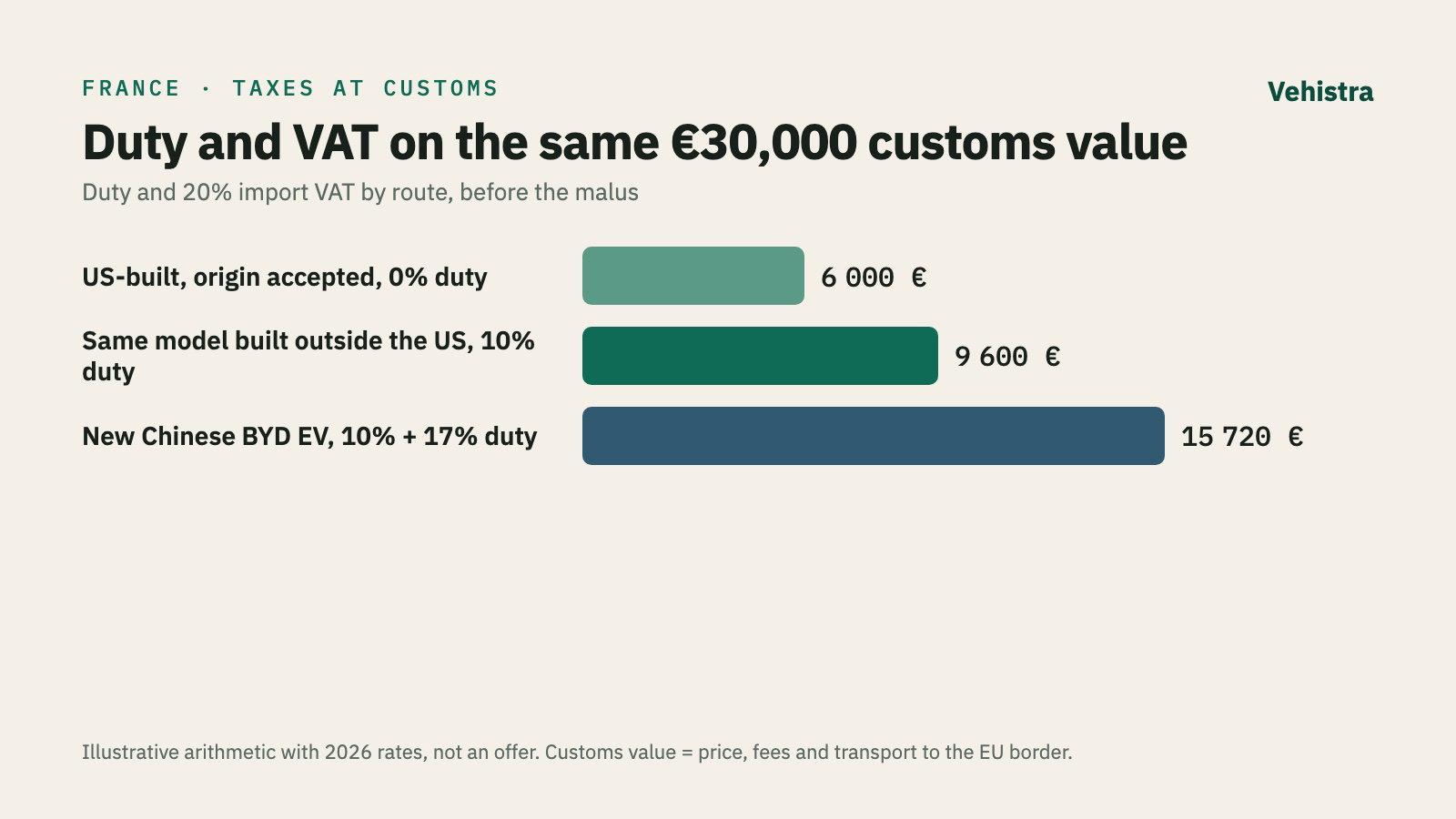
Take a customs value of 30,000 euros. The port of arrival is the first destination, and no further transport or other incidental costs enter the VAT base. The formulas: duty = customs value × duty rate; import VAT = (customs value + duty) × 20%. These illustrate the arithmetic with 2026 rates and are not offers:
French malus on a used US import: CV, weight and age
For a used import, the CO2 and weight grids are those that applied on the car's first registration date abroad. There is no weight grid for first registrations before 2022, and plug-in hybrids first registered from 2022 to 2024 with more than 50 km of electric city range are exempt from the weight malus. The result is reduced by an age coefficient counted in months from that first registration, rounded up: 16% at 13 to 18 months, 28% at 25 to 36, 38% at 49 to 60, 64% at 109 to 120 and 100% from 181 months. The cap on CO2 plus weight malus is reduced by the same coefficient. A car first registered before 1 January 2015 pays neither malus.
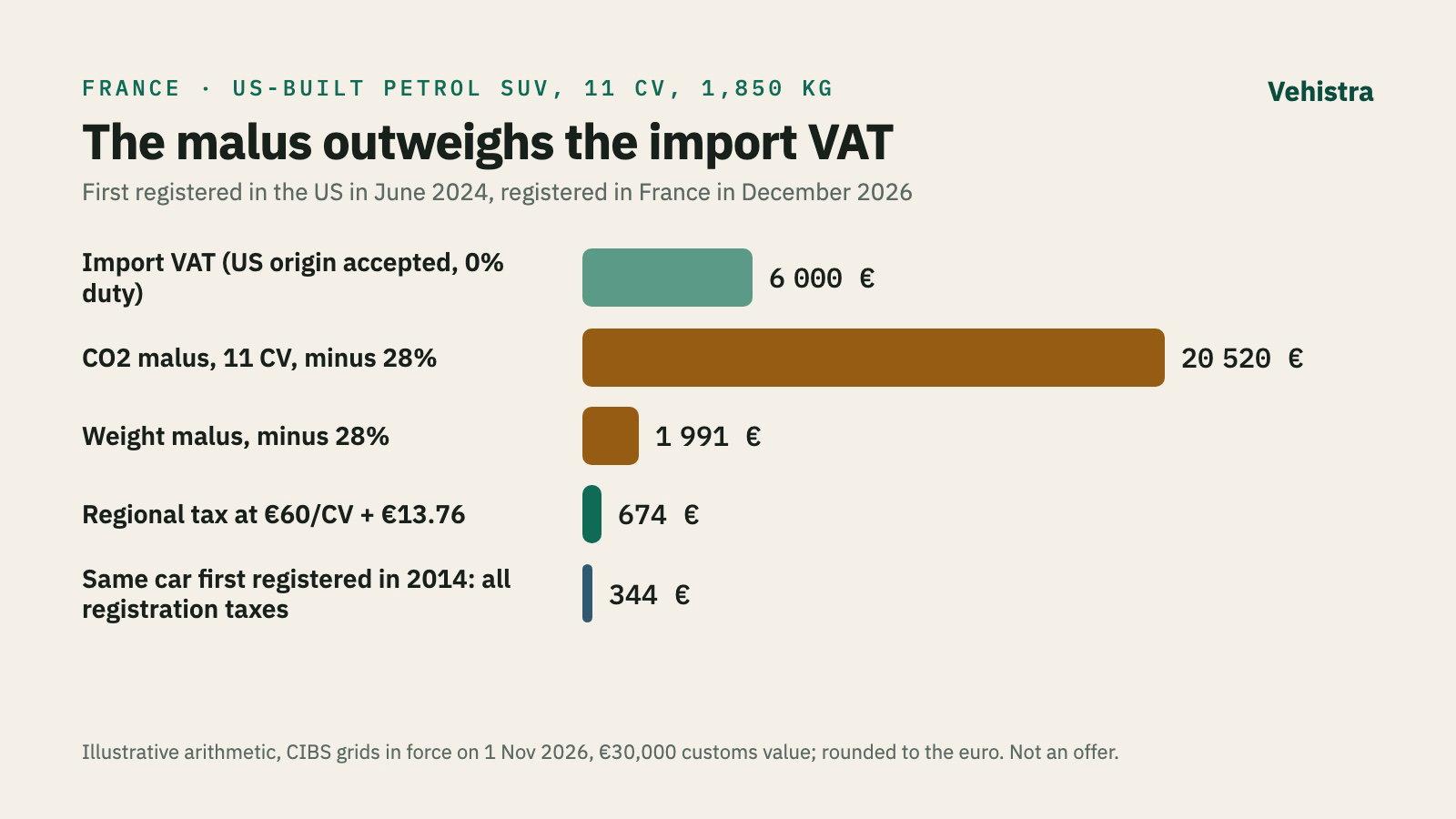
Take a hypothetical US-built petrol SUV first registered in the US on 1 June 2024 and registered in France on 1 December 2026: 30 months old, so a 28% reduction. It is approved individually without European approval, so it is taxed on CV. With 150 kW, the formula in the tax code for passenger cars, 1.80 × (kW/100)² + 3.87 × (kW/100) + 1.34, gives 11.195, rounded to 11 CV; for a car without European approval the authorities set the value with an equivalent method, so treat this as an estimate. Its mass in running order is 1,850 kg. The grids for first registration between 1 January 2024 and 28 February 2025 apply:
The carte grise for this car comes to 23,184.76 euros, almost four times its import VAT. The same car first registered in 2014 would pay no malus, and its regional rate is halved: 11 × 30 + 11 + 2.76 = 343.76 euros. Under these rules, cars first registered before 2015 and pure electric cars pay no CO2 or weight malus; approval, repairs and resale value still decide whether importing them makes sense. For a recent petrol V6 or V8, get the CV and mass estimated before you bid.
When a car already registered in France is cheaper
Selling a French-registered passenger car to a new owner does not trigger another malus, unless the car is modified in a way that newly makes it taxable. The buyer pays only the carte grise taxes: the regional tax, 11 euros and 2.76 euros. A private sale carries no VAT.
The estimated import total = customs value + duty and import VAT + malus + carte grise taxes + costs after clearance + expected repairs + contingency. The examples assume costs after clearance that are outside the VAT base, VAT included: 3,500 euros for the DREAL approval file and tests, lighting changes and the technical inspection, a 3,000 euro repair estimate and a 1,000 euro contingency. Use your own quotes; laboratory tests, storage and a second inspection can cost more. For the two hypothetical SUVs, with the same specification and customs value:
For a comparable SUV already registered in France, add 673.76 euros of carte grise in a 60-euro region to the purchase price. Against the US-built import it is the cheaper buy at any price below 66,011 euros, and below 69,611 euros against the one built elsewhere. Check real listings with the same engine, mileage and history before you decide. For the BYD, compare 47,720 euros with the same version's price at a French dealer.
Compare like with like: a repaired auction car and an accident-free local car differ in history and resale value. If you buy from a professional seller in France as a consumer, the seller is liable for defects of conformity that existed at delivery and appear within two years; for a used car, a defect that appears within twelve months is presumed to have existed at delivery unless the seller proves otherwise (Code de la consommation, L217-3 and L217-7). A car over four years old needs a technical inspection less than six months old when it is re-registered. Before paying for a French car, check the seller's identity and right to sell, check that the VIN matches the carte grise, ask the seller to share the car's HistoVec report with the certificat de situation administrative and look at the inspection report and repair invoices; a French registration says nothing about accident history.
Importing from a US auction to France
A title that can leave the US is not automatically a car France will register. If the title or the approval route cannot be resolved, do not bid: the car may stay unregistrable whatever you spend on repairs. Before you bid:
Our US to France guide covers shipping and customs documents.
Ordering a car from China to France
Several Chinese brands sell officially in France with European approval and a dealer network. A grey import can still make sense for price or a model not sold here, but only if this exact version can be registered and serviced. Before a deposit, get the EU certificate of conformity for that VIN and variant: with it the car is registered online through the ANTS without an individual approval. Check the charging connector and protocol with a demonstrated AC and DC charge. Confirm the drivetrain: a new Chinese-made pure BEV carries the extra duty but no malus; a range-extender car can carry the extra duty and is still assessed for the malus, because it also runs on fuel; a conventional plug-in hybrid pays the 10% duty, and with European approval its malus depends on its CO2 figure and weight. If the manufacturer cannot confirm a valid EU certificate of conformity for that exact car, do not pay a deposit until the French approval route and its cost are confirmed; a generic certificate or one for another variant is not enough. Get in writing who gives the warranty in France and whether parts and diagnostics are available. Our export checklist for new cars from China lists the documents to request.
From the port to French plates
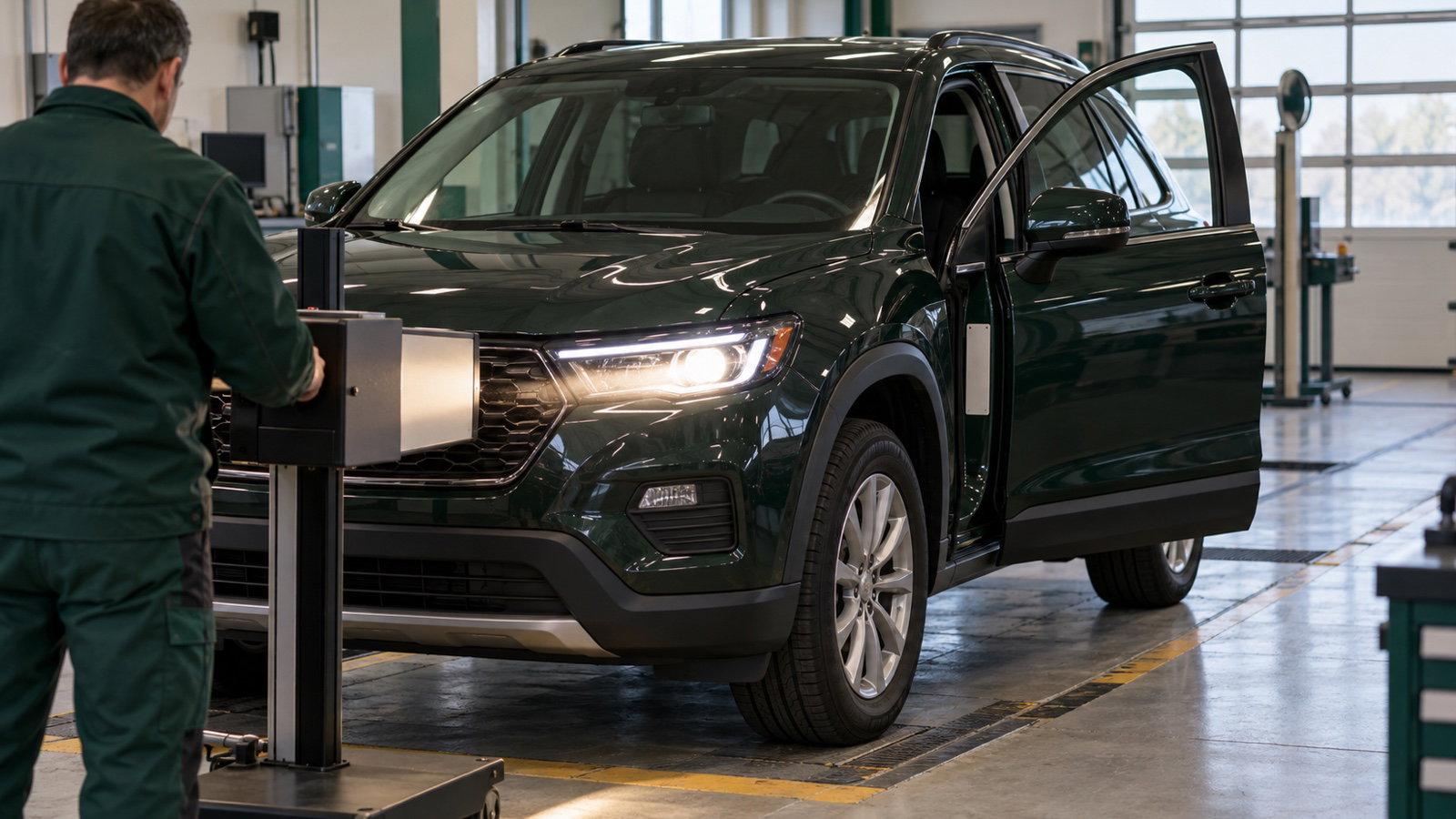
On French roads the car needs valid plates. If its foreign plates are no longer valid, it needs temporary WW plates and a WW certificate. A car that cannot be insured or driven goes to the DREAL inspection on a truck.