
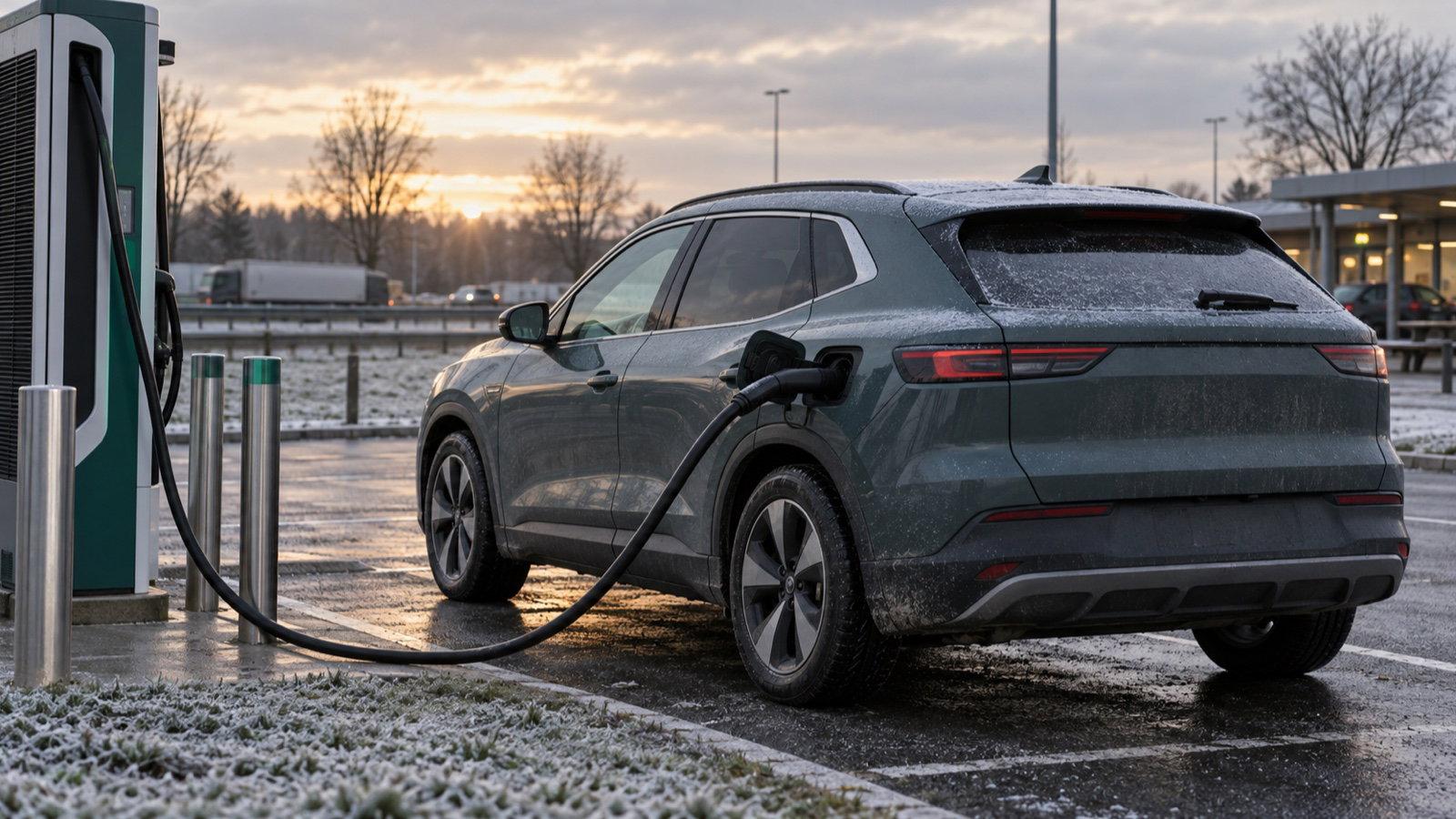
Battery condition weighs heavily on a used electric car's value, and a short test drive will not tell you how much capacity is left. The battery warranty may or may not pass to you, and a car from a US auction can arrive with a charging inlet and a warranty that do not work in Europe. A low price is a bargain only when those questions have answers. This checklist covers a battery-electric car bought in Europe from a dealer or a private seller, and one bought at a US auction without seeing it. Save it before the viewing.
Safety and paperwork first
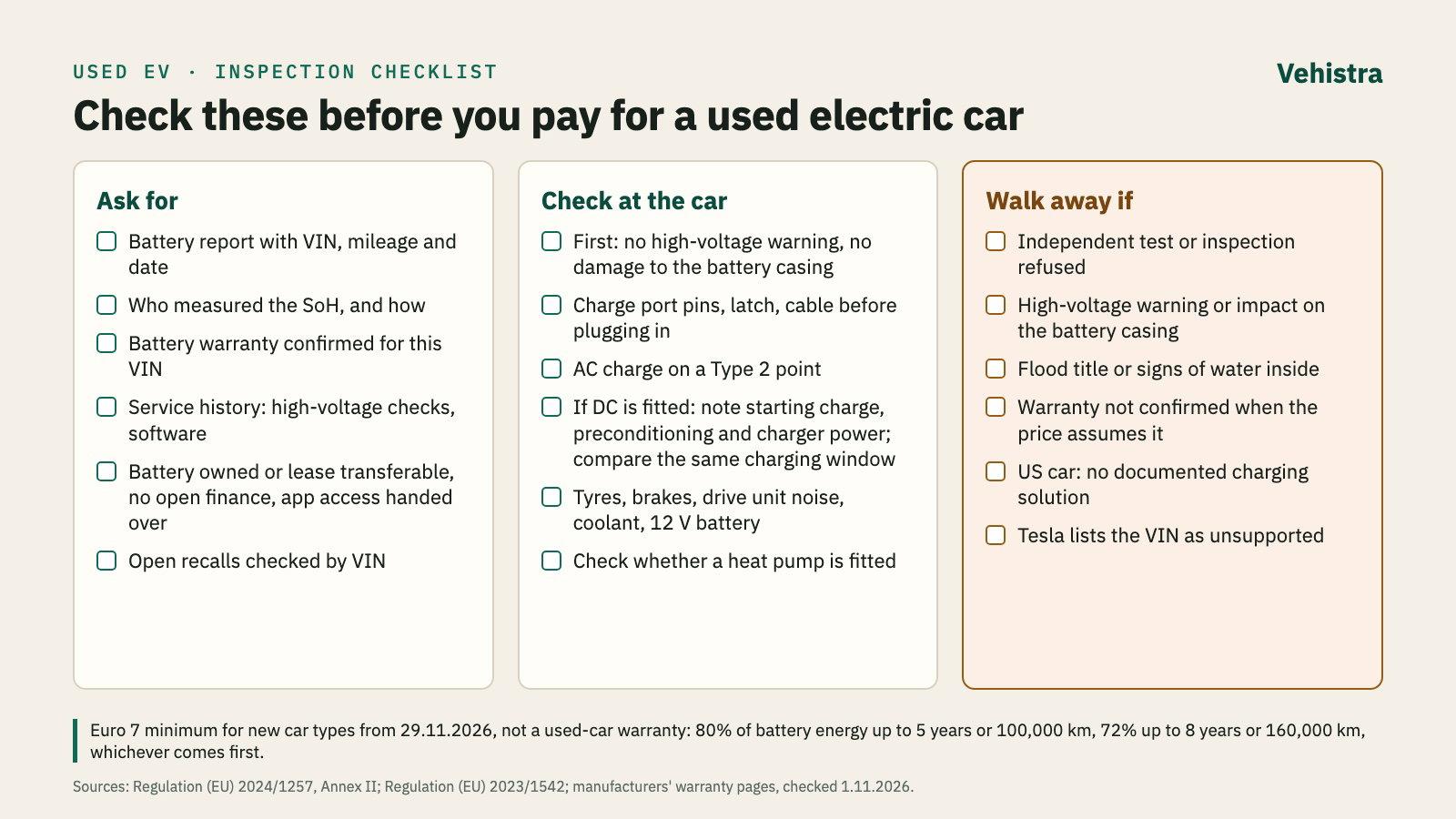
Look for damage before you plug anything in. A high-voltage or insulation warning on the dashboard, dents or deep scrapes on the battery casing, a mud line on the doors or a damp, musty interior mean the car needs an assessment by an EV-qualified workshop before anyone drives or charges it. Do not run the charging tests below on a car like that.
Then check the papers. Is the battery owned with the car, or rented under a separate contract? Is there outstanding finance on the car? Can the seller transfer the car out of the manufacturer's app account and remove their own access? Ask for the service history with high-voltage checks and software updates, both keys and the charging cables that came with the car, and whether the battery or any of its modules were ever repaired or replaced.
Battery health: what each report can prove
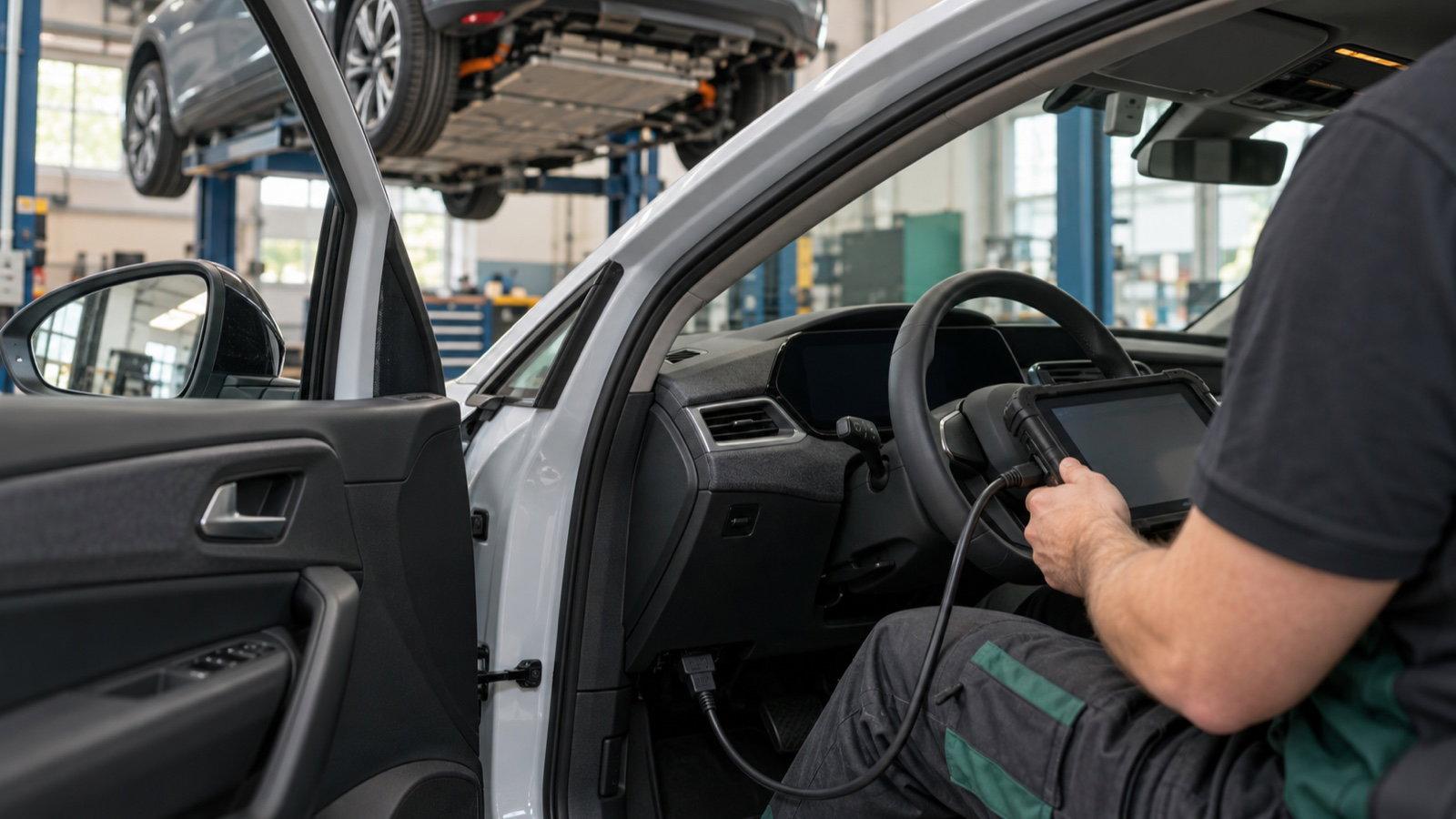
A range figure on the dashboard is not a battery test. Ask for evidence dated and tied to the VIN and the mileage, and know what each kind can and cannot show:
Compare an SoH figure only with one taken by the same method on the same model: DEKRA warns that SoH values from manufacturers' own software can differ considerably between brands. Volkswagen explains that its ID. models estimate capacity more accurately after a calibration charge, so a BMS figure depends on how the car has been charged. Leave calibration to the owner or a workshop.
A good SoH figure does not show that the pack is safe. Have an EV-qualified workshop check the casing, the fault memory, the cooling system and the repair history, and run any further tests the manufacturer prescribes for what it finds.
Battery warranty: read the terms and check the transfer
Battery warranties usually cover capacity that drops below a threshold, typically 70%, within a period of years or kilometres, as well as defects. Depending on the terms, the manufacturer repairs or replaces the battery, and a successful claim does not entitle you to a new battery at 100%. Gradual loss that stays above the threshold is normal wear. Terms on the brands' official pages, checked on 1 November 2026:
Ask the brand's dealer to confirm for that VIN the start date, remaining time and kilometres, past claims and anything that excludes the battery. Get it in writing if the price assumes a valid warranty. The manufacturer's warranty is separate from your legal rights against a dealer who sells you the car.
Charging: test AC and DC under comparable conditions
Before plugging in, check the charge port for bent or burnt pins, a working latch and flap, and corrosion, and the charging cable for damaged insulation and plugs. Burnt contacts need a workshop before any charging.
Plug the car into a Type 2 wallbox or public AC point and check that charging starts and holds the power the car's on-board charger should take on that supply.
If the car has DC fast charging and you will use it, do a session from a low state of charge. Precondition the battery first if the car offers it, note the charger's maximum power and whether it shares power with the next bay, and record the peak power and the time to 80%. Compare that with the manufacturer's figure for the same version and charging window. A slow result on a cold battery or a shared charger proves little. If a session stops or stays far below the published curve, repeat it on another charger before blaming the car.
Winter range and the heat pump
ADAC tested 14 family EVs in its lab (published 22 January 2026) on a recorded 582 km motorway route from Munich to Berlin at 0 °C, averaging 111 km/h. None finished without a charging stop. The Audi A6 Avant e-tron performance went furthest at 441 km and the Tesla Model Y Premium AWD covered 406 km; the Kia EV6 and the Škoda Elroq managed a little over 300 km. The BYD Sealion 7 Excellence AWD stayed under 300 km at 35.3 kWh per 100 km, measured from the DC energy recharged. ADAC noted that every competitive car in the test had a heat pump, which is now standard on many models. These were new cars, and a used one with a weaker battery will do less.
On a used car, check whether that VIN has a heat pump from the factory equipment list, not from the advert. On a cold test drive, check the cabin heating, seat heating and, if fitted, battery preconditioning.
The rest of the car
A battery report adds to an ordinary used-car inspection; it does not replace it. An EV is heavy, so check the tyres' load index against the specification and look for uneven wear. With regenerative braking the friction brakes work less, so look at the discs for rust and scoring and ask when the brakes were last serviced. Listen for whine or knocks from the drive unit, check the suspension and steering, look for coolant leaks and test the air conditioning. A weak 12-volt battery can stop an EV from starting even with a full traction battery, so ask when it was replaced.
Recalls and software
For a car sold in Europe, ask the brand's dealer for open recall campaigns and the installed software version. Some fixes arrive over the air, others need a workshop visit.
For a US-market car, NHTSA's recall search by VIN shows unrepaired safety recalls for vehicles from certain manufacturers. It does not show completed recalls, non-safety campaigns or recalls on international vehicles, and shows recalls older than 15 years only where the manufacturer extends cover. Recently announced recalls may not list every VIN yet. A zero result is not a full recall history. Ask a European dealer of the brand whether it will carry out an open campaign on a US-market VIN.
Buying at a US auction without seeing the car
At Copart or IAAI you usually bid on photos and a condition report, and most of the checks above can only happen after the purchase. Decide before you bid what an inspector can check on site and which risks you will carry.

What EU rules say about battery health
Euro 7, Regulation (EU) 2024/1257, sets a minimum battery durability in type approval. Annex II, Table 1, for passenger cars, battery-electric and plug-in hybrid: at least 80% of certified battery energy from new up to 5 years or 100,000 km, and 72% from there up to 8 years or 160,000 km, whichever comes first. Article 4(6)(d) requires an SoH monitor, Article 4(10) requires that the battery's SoH is made available to the user, and Article 6(6)(b) requires battery durability data to be readable through the OBD port. Under Article 21 this applies to new car types from 29 November 2026 and generally to new cars from 29 November 2027, later for small-volume manufacturers. These are obligations on manufacturers for new cars, not a warranty for a used one; read 80% and 72% as reference points.
The Battery Regulation (EU) 2023/1542, Article 14, requires that from 18 August 2024 the BMS of an EV battery holds up-to-date data for determining its state of health (for EV batteries, the "state of certified energy", Annex VII), with read-only access for whoever legally bought the battery. From 18 February 2027 every EV battery placed on the market or put into service needs a battery passport (Article 77). Its state-of-health data are open only to persons with a legitimate interest (Annex XIII, point 4), defined in a Commission implementing act under Article 77(9). A battery already on the EU market before that date does not need a passport later. Recital 16, however, treats a used battery imported from a third country as placed on the market when it first enters the EU, so for a US car imported from 18 February 2027 ask your importer or registration authority whether a battery passport is required.
Used EVs to avoid: when to walk away
Stop and get an independent inspection if:
Walk away if: