

Episodes 1 to 3 covered the rule and the money: since 1 July 2026 a car built in the United States enters the EU at 0% duty instead of 10%. This episode is about the condition that decides whether you actually get it. The rate is claimed in the customs declaration, and customs can ask you to prove two things: that the car is of US origin and that it came to the EU directly. The measure applies from 1 July 2026 to 31 December 2029 under Regulation (EU) 2026/1455, subject to suspension or safeguard measures.
There is no single certificate
Article 59a, added to the customs code rules by Implementing Regulation (EU) 2026/1422, requires the proof of origin to include evidence of direct transport. It does not create a standard form. German Customs says the same on zoll.de: there is no standardised certificate, and evidence is evaluated freely.
The European Commission's Q&A on Article 59a is blunt about what does not work on its own:
Evidence of US origin
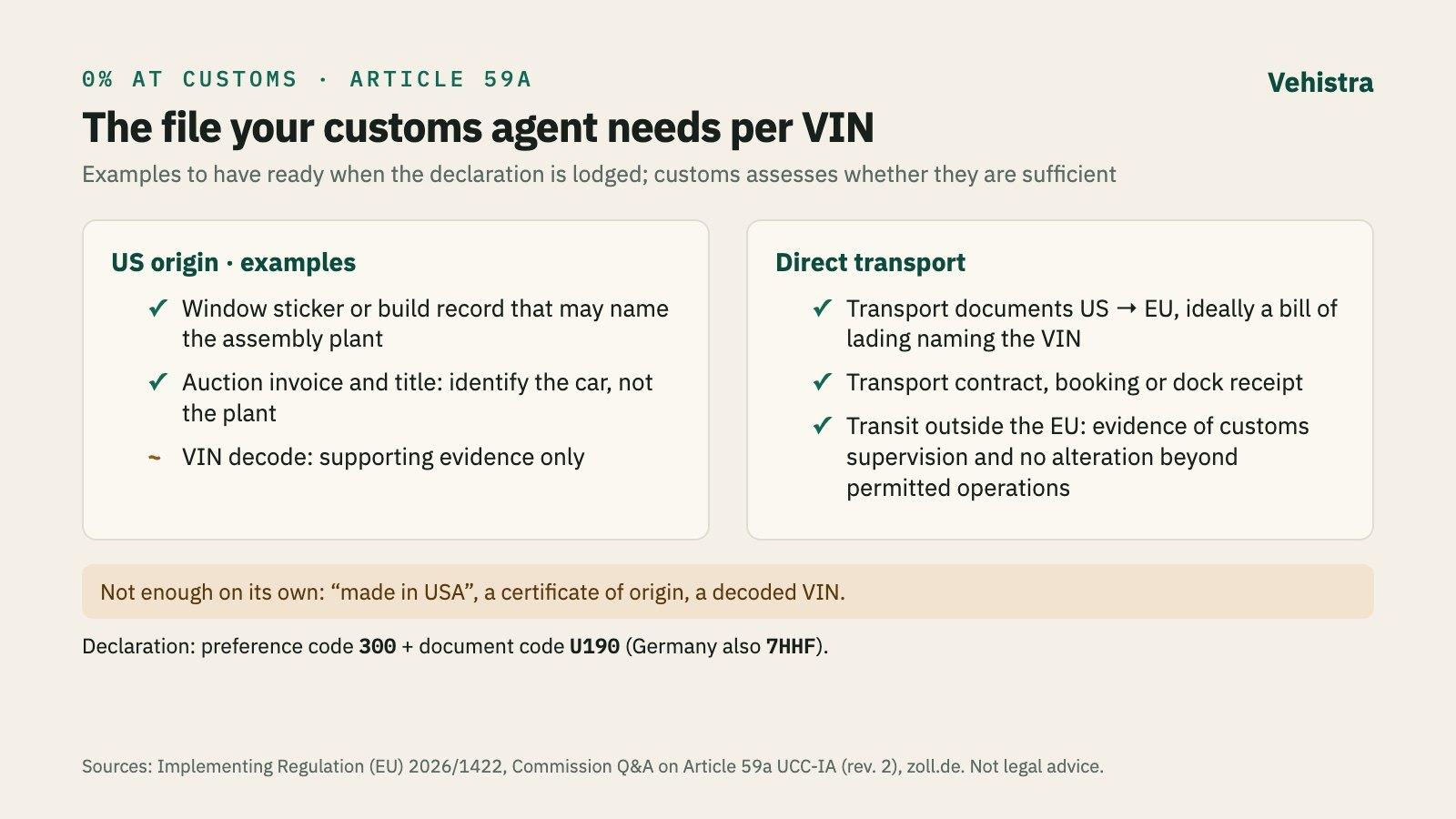
Documents to obtain and assess for each VIN (examples; customs assesses whether they are sufficient):
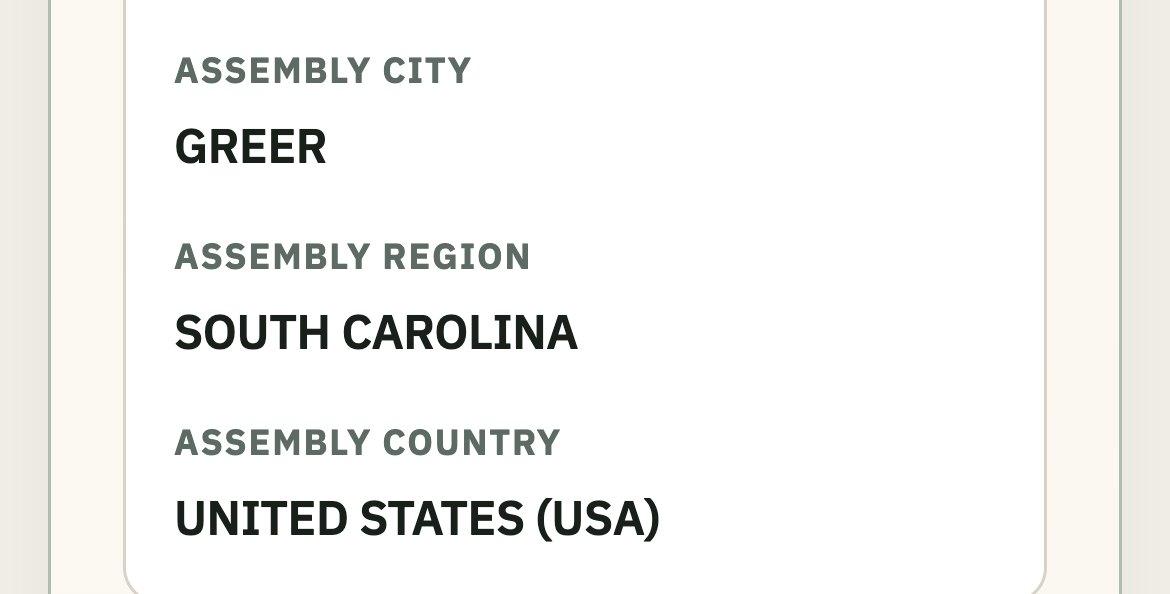
These documents may support US non-preferential origin; they do not guarantee acceptance. Ask your customs agent to assess the available manufacturing evidence for this VIN before you bid, and ask the seller for the window sticker. For a damaged auction car it is often missing, and that is exactly when the rest of the file matters.
Evidence of direct transport
For sea freight, obtain transport documents tracing the car from the US to the EU and linking the shipment to its VIN. A bill of lading naming the VIN is useful; customs assesses the complete documentary chain, including any third-country transit. Add the transport contract and the booking or dock receipt. The Commission lists transport documents, sales and transport contracts and packing markings as examples.
Transit through a third country does not rule out 0%, but for 0% duty you must document customs supervision and non-manipulation there. Permitted operations are preservation in good condition and adding marks, labels, seals or documentation to meet specific requirements. Evidence can be customs transit documents or a non-manipulation certificate from that country's authorities.
When and how it is declared
The declarant must hold the evidence and have it available to customs when lodging the declaration claiming 0%, not collect it afterwards. Your agent claims the rate with preference code 300 and document code U190; in Germany the national code 7HHF is added for direct transport. The documents themselves go to customs when it asks.
If the car is US-built but neither direct transport nor qualifying transit can be shown, the Commission's answer is short: the 0% rate cannot be applied.
Cars that arrived before 1 July 2026
There is no transitional rule, but documents from before 1 July 2026 can be accepted. A US-built car that entered the EU earlier and stayed under customs supervision, for example in temporary storage, can get 0% if it is released for free circulation after that date and the origin and transport conditions are met.