
Earlier in this series we looked at the EU duty on Chinese EVs, the hybrid exception and how the customs value is built. Here we put it together: one €30,000 purchase price, two powertrains, three countries. We ran the Vehistra import cost calculator on 1 November 2026 for a BYD electric car with the 17% countervailing duty and for a 1.5-litre plug-in hybrid with 30 g/km CO₂, on the China export route with default costs, landed in Germany, Poland and Spain.
The full bill
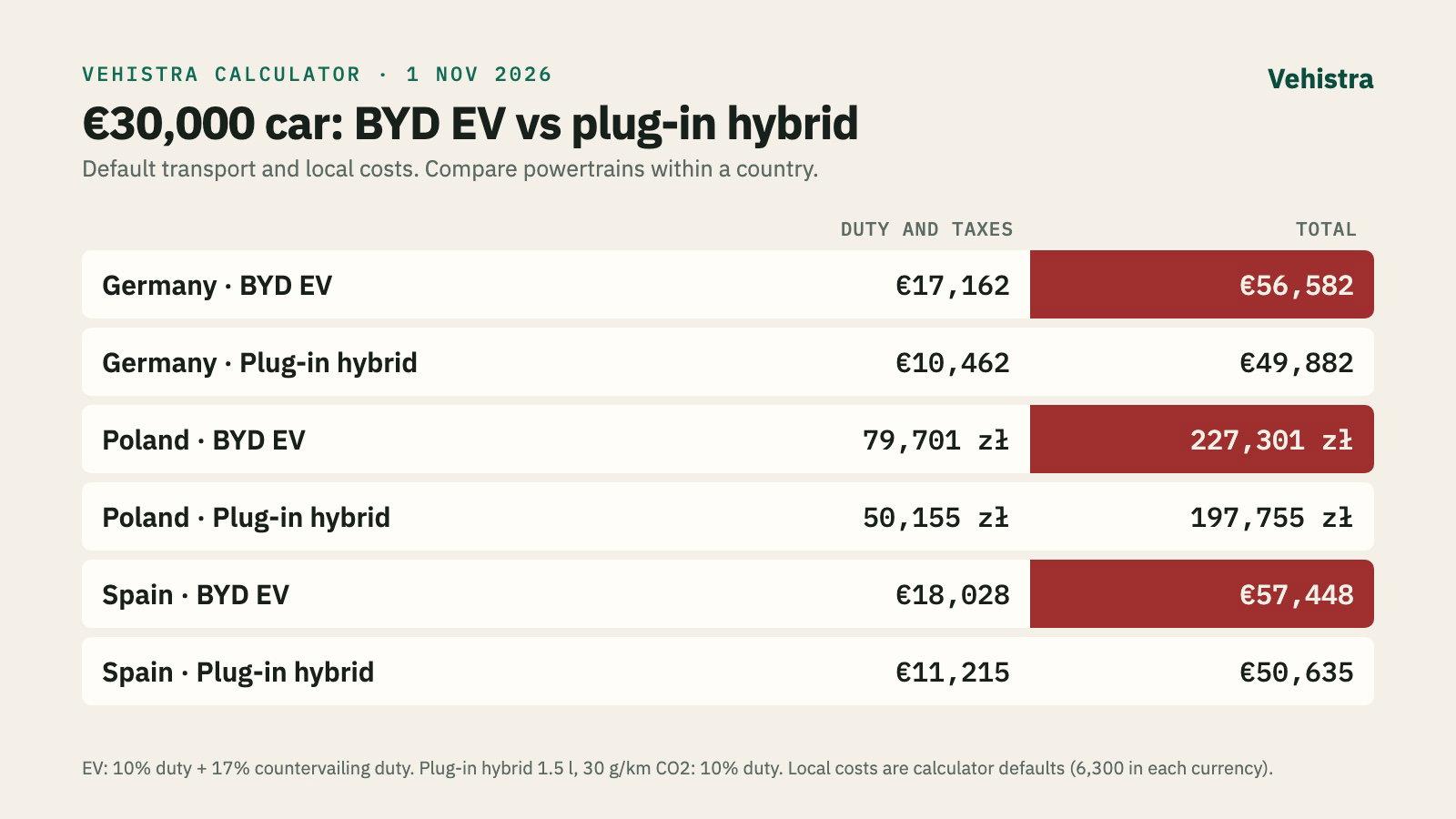
Germany
Poland (1 EUR = 4.27 zł)
Spain
What makes the difference
The extra EU duty. Only new battery-electric cars pay it, at a rate set per manufacturer. BYD's 17% is the whole gap between the two powertrains in Germany: about €6,700 once VAT is counted. A Tesla from Shanghai would pay 7.8%, an MG from SAIC 35.3%. The rates per manufacturer and the invoice rule are in the first part of this series.
The VAT rate. Import VAT is 19% in Germany, 23% in Poland and 21% in mainland Spain. Its base includes the customs value, the duties and the costs to the destination, so a higher duty is taxed again.
National tax. Poland charges excise by engine size; both our cars pay 0%, but a full hybrid up to 2.0 litres would pay 1.55%. Spain charges registration tax by CO₂; both pay 0% here, but a full hybrid with an official 125 g/km falls in the default 4.75% band, so check your region's rate. Germany has no registration tax. The hybrid guide has the full rate tables.
Local costs are defaults, not quotes
The €6,300 of local costs covers the customs broker, port handling, inspection, required modifications, registration, an insurance or warranty estimate and a risk buffer. The calculator uses the same default figure in each country's currency, so the Polish line is 6,300 zł while the German and Spanish lines are €6,300. That is why this article does not rank the three countries. Real costs depend on the port, the broker and the approval route; a China-market car that does not match an EU-approved type needs an individual approval, which can cost more.